

WASHINGTON – “Swipe” fees banks charge merchants to process credit card transactions will drive up the price of school and college supplies by $3 billion this year and cost the average family between $20 and $30, the Merchants Payments Coalition reported Monday.
“With swipe fees constantly rising, this hidden tax takes more out of families’ school supply budgets every year,” MPC member and National Association of College Stores Vice President of Government Affairs Richard Hershman said. “This is money that could go to children’s educations or helping families make ends meet, but it lines the pockets of credit card company executives and Wall Street bankers instead. Credit card companies get away with this because of lack of competition. Congress needs to stand up for families and their children by passing the Credit Card Competition Act.”
Averaging 2.35% of the transaction but ranging as high as 4%, swipe fees are most merchants’ highest operating cost after labor and have to be built into pricing. With few consumers using cash and credit card rules making discounts difficult, all shoppers pay more because of swipe fees regardless of how they pay.
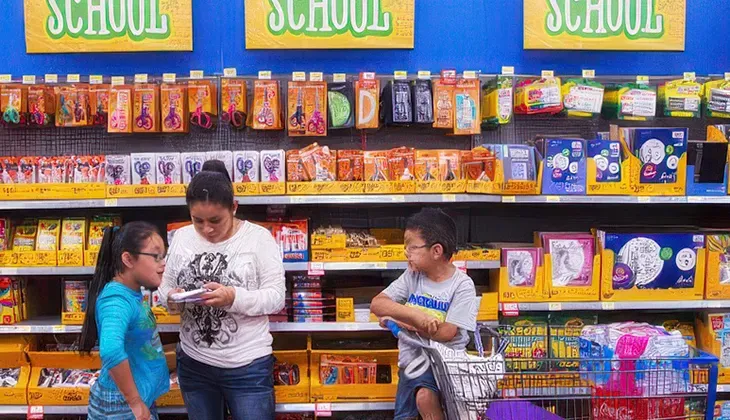
Families are expected to spend an average $858 on K-12 school supplies, clothing and related items for a total of $39.4 billion this year, according to the National Retail Federation. While a precise amount is difficult to calculate, MPC estimates that swipe fees account for $20 of the per-family cost and $925.9 million of the total.
Back-to-college spending is expected to average $1,326 for a total of $88.8 billion, resulting in swipe fees of $31 on average and $2.1 billion overall. Together, back-to-school and back-to-college swipe fees could total $3 billion.
K-12 families are expected to spend an average $144 on school supplies like pencils and notebooks, including an estimated $3.38 in swipe fees; $296 on electronics like calculators, or $6.95 in swipe fees, and $418 on clothing and shoes, including $9.83 in swipe fees. For college, spending should average $91 for college-branded gear (including $2.13 in swipe fees), $93 for school supplies ($2.18), $191 for dorm furnishings ($4.50), $278 for clothing and shoes ($6.54) and $310 for electronics ($7.27).
The $20 in swipe fees for a K-12 family is equal to the cost of a school lunchbox while the $30 college average would buy a backpack.
Swipe fees account for $2 of the $85 price of a typical school-recommended list of pencils, crayons, paper and similar supplies for a first-grader. In high school, the fees can total $3.50 on the $150 graphing calculator required for an algebra class and over $3 for a basic $135 supply list. And they amount to $11.25 on a $480 laptop.
Swipe fees for Visa and Mastercard credit cards alone have more than quadrupled since 2010 to $111.2 billion last year. Total credit and debit card swipe fees hit a record $187.2 billion, driving up prices by nearly $1,200 a year for the average family.
The impact on school spending comes as Congress is considering the Credit Card Competition Act to address swipe fees, which are too much for small merchants to absorb and drive up prices by nearly $1,200 a year for the average family. The fees are rising largely because Visa and Mastercard each centrally set the swipe fee rates charged by all banks that issue cards under their brands and restrict processing to their own networks.
Under the bill, banks with at least $100 billion in assets would enable credit cards to be processed over at least one unaffiliated network like Star, NYCE or Shazam in addition to Visa or Mastercard. The measure is expected to result in competition over fees, security and service that would save merchants and their customers $17 billion a year.
Credit card ‘Swipe’ fees account for $3B of back-to-school costs in 2025
Fees can cost an average family as much as a lunchbox or backpack.
Related

JJ Fleeman to succeed Todd Vasos as CEO at Dollar General effective January 1, 2027
The board intends to appoint Fleeman to serve as a director upon the effective date of the transition.

JJ Fleeman, CEO of Ahold Delhaize USA, to step down at the end of June
Fleeman has spent his entire 36-year career in grocery retail with Ahold Delhaize companies, including Food Lion, the organization’s largest U.S. brand.

NRF: Easter spending poised to hit record $24.9B
Candy is the leading shopping category for Easter this year, with 92% of consumers planning to purchase sweets.

A new Ferrero Easter Candy Survey reveals that adults want Easter baskets too
Two-thirds of North American adults (66%) say they deserve an Easter basket just as much as children do.
Latest

NACDS Foundation to host 28th Annual Dinner with Jim Gaffigan at Total Store Expo
Gaffigan, an eight-time Grammy-nominated comedian and three-time Emmy winner, is known for his observational humor and global touring success.
JJ Fleeman to succeed Todd Vasos as CEO at Dollar General effective January 1, 2027
The board intends to appoint Fleeman to serve as a director upon the effective date of the transition.
JJ Fleeman, CEO of Ahold Delhaize USA, to step down at the end of June
Fleeman has spent his entire 36-year career in grocery retail with Ahold Delhaize companies, including Food Lion, the organization’s largest U.S. brand.

ShipStation Intelligence taps shipment data to optimize fulfillment, delivery and returns
New AI-powered ShipStation Intelligence delivers double-digit shipping cost reductions for merchants.