CHICAGO – A recent analysis by global consultancy Kearney, in partnership with members of the [w]Health advisory board, reveals that $34 billion in private capital has flowed into women’s health since 2020. Of this, $21 billion has been invested in conditions unique to women, such as reproductive care, while $13 billion has targeted conditions that disproportionately affect women, including brain health, cardiovascular disease, and autoimmune disorders.
The findings are part of Kearney’s Accelerating private capital investment in women’s health report, released by the newly established Kearney Health Institute, which brings together leaders from healthcare and life sciences to provide foresight on the forces shaping global health systems. The report analyzed over 2,000 private deals exceeding $1 million, showcasing notable progress while underscoring persistent funding gaps that continue to hinder innovation.
Capital is flowing, but narrowly focused
The majority of funding ($21 billion) was directed at women-specific conditions, including fertility, reproductive care, and women’s cancers such as breast and ovarian. Fertility alone attracted $7.9 billion, followed by $3.6 billion into breast cancer and $1.7 billion into broader gynecological diseases.
However, when compared to healthcare issues that disproportionately impact women:
• Alzheimer’s disease, which disproportionately impacts women, attracted only $2.6 billion.
• Ischemic heart disease received just $2.1 billion, even though cardiovascular disease is the leading cause of death among women.
• Autoimmune gut diseases, which affect women at up to 10 times the rate of men, received $2.1 billion.
• Depressive and anxiety disorders, both more prevalent among women, drew $1.3 billion and $0.7 billion.
• Depressive and anxiety disorders, both more prevalent among women, drew $1.3 billion and $0.7 billion.
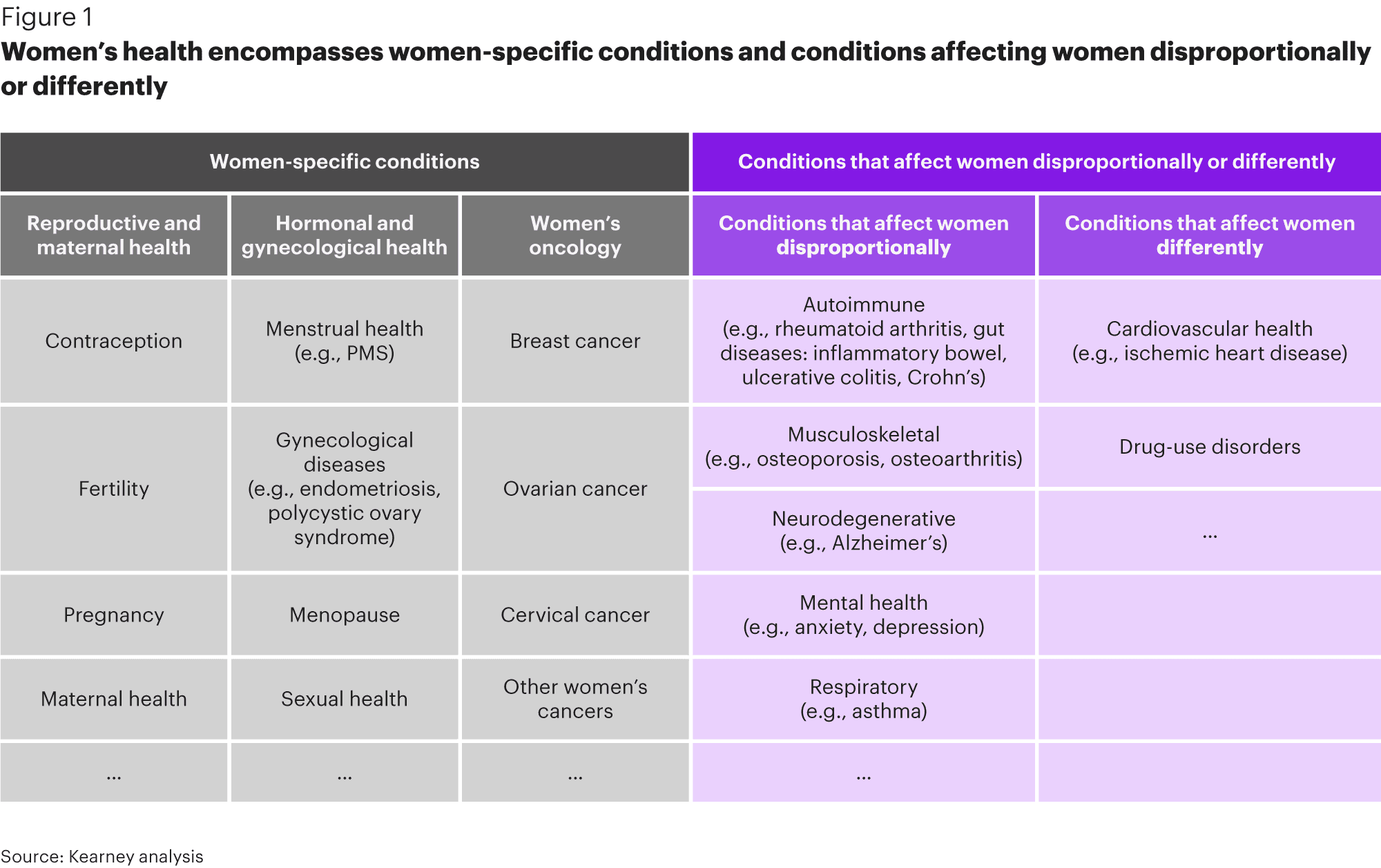
This disconnect between investment patterns and actual disease burden is not just a clinical issue—it’s also a missed economic opportunity. According to the World Economic Forum, aligning capital with women’s health needs could unlock $1 trillion in global economic output annually by 2040.
Where investment needs to go next
Most funding so far has gone into areas such as fertility and cancer, but the report highlights other parts of women’s health that are still being overlooked. These include hormonal conditions, heart and immune system diseases, and mental health.
The distribution of investment also reveals gaps in women’s health, with drug interventions attracting the largest capital ($1.8 billion), while care interventions accounted for $11.4 billion. Diagnostics and digital health innovation—which could help detect problems earlier—received investments of just $7.6 billion, offering real opportunities for investors looking for what’s next. Paula Bellostas-Muguerza, partner at Kearney, said: “Women make up half the population, but healthcare still isn’t designed for them. Their symptoms are overlooked, their conditions under-researched, and the capital intended to fix that is missing the mark. Fertility and oncology continue to dominate funding, not because the need is greatest, but because they’re more familiar to investors. Meanwhile, conditions that disproportionately affect women, including high-burden areas like heart disease, autoimmune disorders, and mental health are being left behind.
“While private capital is finally moving into women’s health, it’s still stuck in a narrow lane. We need to fund not just different diseases, but different investment pathways like diagnostics, digital health, and integrated care platforms to deliver faster, broader impact. If we get that right, women’s health could become one of the most transformative and high-growth sectors of the next decade.”
Submit Your Press Release
Have news to share? Send us your press releases and announcements.
Send Press Release