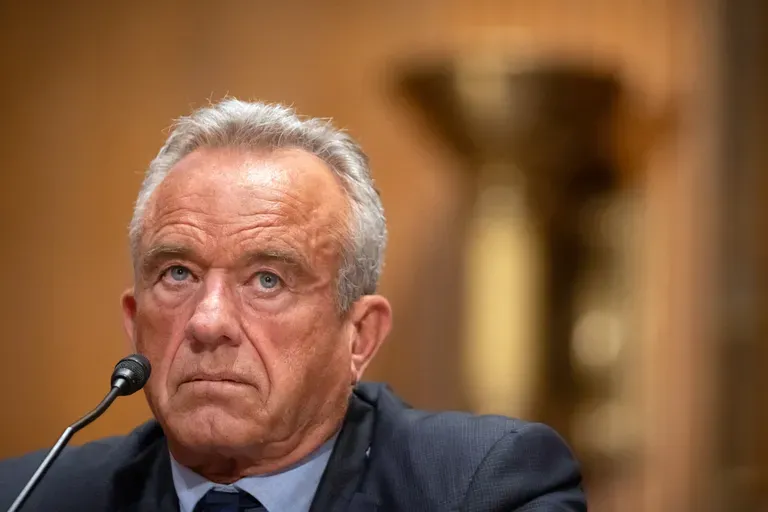
WASHINGTON — When the “Make America Healthy Again” (MAHA) Commission unveiled its long-awaited report on children’s health this morning, HHS Secretary Robert F. Kennedy Jr. framed the effort as nothing less than a national reset. Chronic illness in children, Kennedy argued, is an epidemic fueled by ultra-processed foods, synthetic chemicals, psychiatric medications, screen time, and stress. The MAHA roadmap pledges to restore full-fat milk in schools, define and limit ultra-processed foods, and push for greater transparency in pesticide approvals and drug marketing.
In announcing the report, Health Secretary Robert F. Kennedy Jr. described chronic disease in children as “an existential crisis for our country” and stated that the report’s 128 recommendations are “historic and unprecedented.”
“There’s never been an effort like this across all the government agencies,” he said.
Shortly after the report was released, it was met with a wave of skepticism from researchers, advocates, and public health experts, not only regarding its conclusions but also about the shaky evidence it cites.
Dr. Philip J. Landrigan, a Boston College pediatrician and director of the Program for Global Public Health and the Common Good, said that “the report contains no recommendations on how to reduce children’s exposures to toxic chemicals in food other than food dyes and heavy metals in infant formula.”
Lofty Goals, Controversial Prescriptions
The MAHA report presents an ambitious agenda: tighter controls on food dyes, new nutritional standards for infant formula, support for breastfeeding, recognition of excessive screen time as an addiction, and expanded NIH research into the microbiome, autism, and vaccine injury. It also calls for more openness in chemical safety reviews and food labeling.
People who report vaccine injuries “will be welcomed and we will learn everything we can about them so we can improve the safety of these products,” Kennedy said Tuesday.
Yet beneath its sweeping recommendations, critics say, lies a document riddled with factual gaps and questionable policy logic.
A Light Touch on Industry
Beyond the citation scandal, many in the public health community are frustrated by the report’s regulatory stance. Instead of mandating stricter limits on pesticides, additives, or processed foods, the plan leans heavily on voluntary industry action, educational campaigns, and market incentives.
“This is a strategy that goes easy on the very industries shaping the unhealthy food environment,” said a statement from the Center for Science in the Public Interest. “We don’t need more voluntary guidelines; we need enforceable standards.”
Vaccine Skepticism Rekindled
Perhaps most controversially, the MAHA roadmap questions long-established childhood vaccine schedules, raises concerns about cumulative exposure, and calls for further study of vaccine injury. Public health leaders warn this language could fuel hesitancy and erode confidence at a time when preventable diseases remain a global threat.
“Framing vaccines as a problem rather than a solution risks undermining decades of progress,” said Dr. Anne Schuchat, former CDC official. “The real danger here is confusing parents and opening the door to outbreaks.”
“This administration’s unprecedented cuts to Medicaid and SNAP, along with its chaotic, confusing actions restricting vaccine access, are worsening – not resolving—efforts to improve children’s health,” said Dr. Susan J. Kressly, president of the American Academy of Pediatrics.
“What we’re seeing now is an ideological decision about what the answer should be and then a backfill of individuals on the advisory committee and working groups, and so forth, to get to that decision about what we want the answer to be, on a question of vaccine safety, and then let’s manipulate the data to get there,” said Dr. Anne Schuchat, former Principal Deputy Director of the CDC, recently about the MAHA effort.
Industry Responds: FMI’s Shared Goals
Not all responses were critical. The Food Industry Association (FMI), which represents food retailers and suppliers nationwide, used the report’s release as an opportunity to highlight its own role in advancing public health.
“FMI shares the administration’s commitment to making Americans healthier,” said FMI President and CEO Leslie G. Sarasin. “We agree that nutrition and food as medicine play foundational roles in health, and we are proud to be a critical part of this effort.”
Sarasin pointed to FMI member initiatives that expand access to affordable produce, support SNAP and WIC families, and provide healthier choices across store aisles. She emphasized September’s National Family Meals Month as an example of how retailers are promoting well-being by encouraging families to eat together — a practice linked to improved mental, emotional, and physical health.
“As the work to make America healthier continues, we urge policymakers to recognize the critical role that food retailers and their supplier partners play in delivering affordable, nutritious foods to families across the country,” Sarasin added.
A Divided Reception
To Kennedy’s supporters, the MAHA report represents a bold attempt to confront systemic issues: food marketing to children, over-reliance on psychiatric medication, and the commercialization of healthcare. To critics, it’s a deeply flawed document, one that undermines trust in Science while failing to offer the regulatory muscle needed to shift outcomes.
“I’m very happy to see that they’ve identified diet and physical activity as two of the top health problems in the U.S.,” says Lindsey Smith Taillie, professor of nutrition at the Gillings School of Public Health at UNC Chapel Hill. “But this report was lacking actual, meaningful action that would help Americans address our problems.”
Already, more than 3,000 health professionals in the coalition Defend Public Health have called for Kennedy’s removal, arguing that the initiative is a distraction from evidence-based priorities such as poverty reduction, food security, and expanding healthcare access.
“How can we “Make America Healthy Again” unless we renew our commitment to ensuring access to food for children,” and other Americans, asks Eric Mitchell, President of the Alliance to End Hunger, in a statement.
What Comes Next
The Trump administration has yet to indicate how quickly the MAHA recommendations will move into policy. Agencies from USDA to EPA are named as partners, but many of the proposals would require congressional approval or significant shifts in regulatory frameworks.
For now, the MAHA roadmap remains both a political statement and a public health lightning rod, a document meant to reshape the conversation about childhood health, even as it sparks fierce debate over whether it can, or should, shape policy.