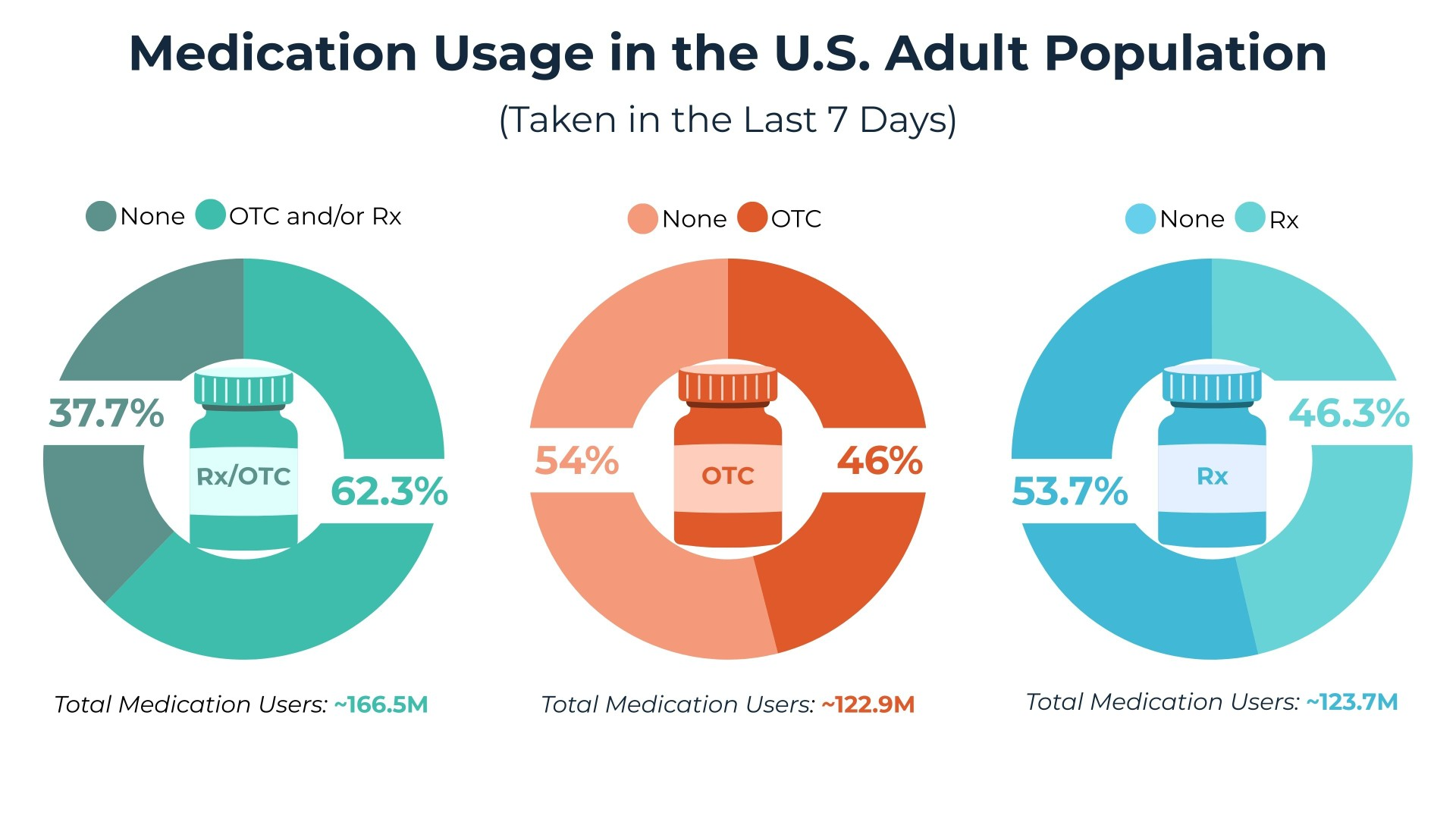
WASHINGTON, D.C. – A new, nationally-representative study published in the peer-reviewed medical journal JAMA Network Open provides a detailed picture of U.S. adults’ use of over-the-counter (O-T-C) and prescription medications. The study finds that nearly two-thirds (62%) of U.S. adults — approximately 166.5 million people — reported using at least one medication in the past seven days. Notably, 46% of those surveyed reported the use of an OTC medication during that same period, often to address everyday, self-treatable healthcare.
Rather than focusing on prescriptions written or medications taken at any point during an individual’s lifetime, the study, Prevalence of Over-the-Counter and Prescription Medication Use in the US (Green et al, 2026), captures a snapshot of recent, self-reported use. Within a seven-day period, OTC and prescription medicines were reported at nearly identical rates, reflecting the co-use of different types of medicines within the same week to address distinct health needs.
“These findings show that O-T-C medicines are an important part of everyday health management for millions of Americans,” said CHPA president and CEO Scott Melville. “As policymakers consider new approaches to improve the accessibility and affordability of healthcare, it’s important to recognize the vital role O-T-C medicines already play in helping Americans manage healthcare needs. And supporting that role through sound policy, regulatory rigor, and public education remains a CHPA priority.”
“Usually, medication evidence comes from prescriptions dispensed by pharmacies or products sold,” said Jody Green, principal investigator of the study, “but in this study we focused on what people actually used in the past seven days, which provides a clearer picture of how American adults manage their health conditions in daily life.”
What the Study Measured
Adults often manage multiple health concerns at once, using more than one medication during a given week. The study evaluated recent, self-reported use of O-T-C and prescription medications across a range of common conditions, including both single-ingredient and fixed-dose combination products.
No information was collected on the care settings in which medications were taken or on health outcomes. The findings reflect how U.S. adults report managing their individual health needs through the use of both O-T-C and prescription medications. Prescription medications are commonly used for more serious or longer-term conditions, while O-T-C medicines are frequently used to manage short-term and everyday ailments.
What Americans Use Most
The published study identified the most commonly used Rx and O-T-C medicines reported by U.S. adults in the past seven days. The list includes familiar O-T-C products alongside widely used prescription medicines for chronic conditions, reflecting the mix of self-care and clinician-directed treatments people report using in everyday life. This mix underscores an important reality: healthcare is not an either-or proposition. It is a continuum in which consumers responsibly combine self-care and clinician-guided treatments to meet their needs.
“It’s also notable that several of the most commonly used O-T-Cs on the list were once only available by prescription,” continued Melville. “Over the years, O-T-C medications — like naproxen, omeprazole, cetirizine, and loratadine to name a few — went through FDA’s Rx-to-O-T-C switch process to change their status from prescription-only access to O-T-C. Their appearance on the list among the most commonly-used medicines is a great example of how smart regulatory changes can expand consumer access to safe and effective treatments for better self-care.”
Notably, the four most commonly used medicines overall — acetaminophen, ibuprofen, aspirin, and naproxen — are all available over the counter, with the top three unchanged from patterns observed in national medication use surveys conducted approximately 25 years ago. The top 20 most commonly used medications include:
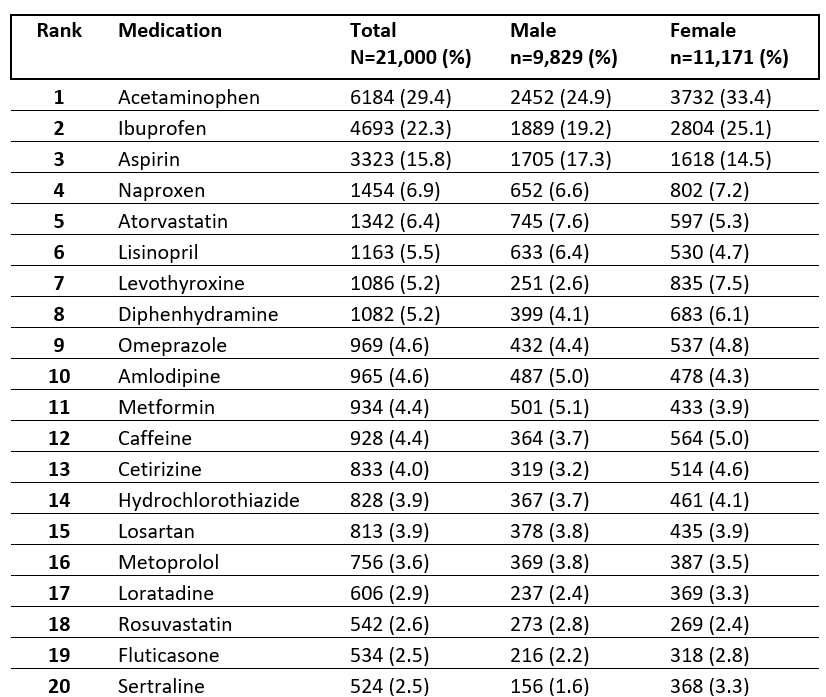
Source: Green, et al (2026), Table 3
OTC Medicines in Everyday Use
One of the key findings of the study is the extent to which O-T-C medicines are used for self-treatable health concerns. Overall, six of the 10 most commonly used medicines identified in this study are available, or primarily available, as an O-T-C medication.
OTCs, Self-Care, and Health Policy
These findings provide updated, real-world context on how Americans use both Rx and O-T-C medicines as part of everyday health management. By documenting recent medication use rather than prescriptions written or products sold, the study offers relevant data to inform ongoing discussions about self-care, access, and the appropriate role of nonprescription medicines within the broader healthcare landscape.
Study Methods
Researchers conducted a large, nationally representative survey of U.S. adults, asking participants to report all prescription and O-T-C medicines they had used in the previous seven days. Responses were statistically weighted to reflect the U.S. adult population. By focusing on recent use rather than prescriptions written or lifetime recall, the study captures actual medication use within a defined, seven-day reporting period.
- Sample size: 21,000 U.S. adults
- Timeframe: June 2023 through April 2024
- Recall window: Past seven days
Additional study details, including full methodology and detailed findings, are available in this fact sheet. See the full article here.
Submit Your Press Release
Have news to share? Send us your press releases and announcements.
Send Press Release