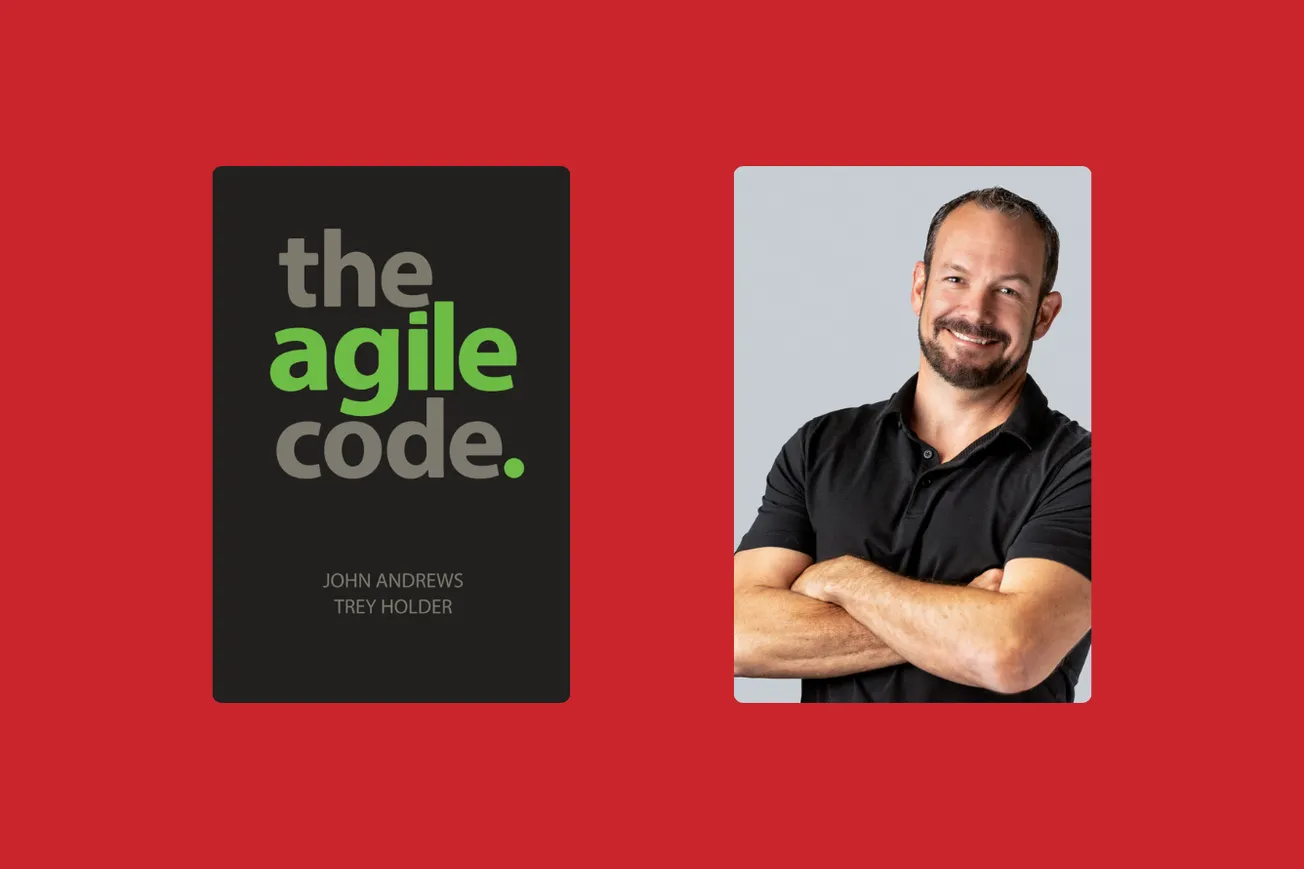
In a marketplace defined by disruption, agility has become the ultimate currency of leadership. That’s the core message of “The Agile Code” (August 2025), the new book by John Andrews and Trey Holder. Far from another management theory text, the book offers a field-tested blueprint for leaders navigating constant change—whether in retail, CPG, technology, or beyond.
With case studies ranging from Patagonia to Starbucks, and lessons drawn from Navy SEALs to ancient armies, The Agile Code shows how organizations can move fast, stay aligned, and remain anchored in purpose.
To unpack the ideas behind the book and why agility matters now more than ever, retailmediaIQ sat down with co-author Trey Holder for a conversation on leadership, adaptability, and what it really takes to thrive in 2025 and beyond.
Trey is a Co-Founder and Managing Partner of The Agile Group and President, Brand Innovators.
retailmediaIQ: Trey, “The Agile Code” couldn’t have landed at a better time. The retail, CPG, and media landscapes are undergoing seismic shifts. What inspired you and John Andrews to write this book?
Trey Holder: Thank you. Honestly, it came from the trenches. Between the two of us, we’ve spent decades inside organizations from legacy players, high-growth startups, retail innovators, etc, watching teams struggle with one fundamental reality: the old playbooks don’t work anymore. Change is no longer episodic. It’s constant. And we saw a gap in how leaders were navigating that. “The Agile Code” is our field guide for surviving and leading inside that chaos.
retailmediaIQ: You mention the book isn’t a textbook but a field guide. What does that mean in practical terms?
Trey: It means this book is built for doers. Operators. Founders. Executives. People who don’t have time for theory. They need frameworks they can implement Monday morning. So, we focused on four core pillars: Adaptability, Collaboration, Constant Improvement, and Experimentation and an underlying theme that you must be obsessed with your customer. Each one is backed by real-world case studies, tactical toolkits, and scorecards to help leaders assess their teams and move fast. Think of it like an agility operating system.
retailmediaIQ: Customer obsession leads off the book. Why is that the foundation?
Trey: Because in a world moving this fast, your only true compass is your customer. If you’re not obsessively close to them emotionally, behaviorally and operationally, then you’re flying blind. We tell the story of one tweet from a mom in Iowa about an empty baby formula shelf that triggered a full-blown response chain at a national retailer. That’s not a fluke. That’s what a customer-obsessed organization looks like in 2025: real-time, reflexive, responsive.
retailmediaIQ: Let’s talk adaptability. How does that manifest today in industries such as retail and sports?
Trey: Adaptability is the difference between being fast and being first. Nike’s 2024 pivot away from a pure DTC model and back toward wholesale wasn’t a failure; it was maturity. In sports, we see the same thing. Coaches like Jerritt Elliott at Texas Volleyball are rebuilding top-ranked teams overnight because the NIL and transfer rules changed everything. If you’re rigid, you’re toast. Adaptability isn’t about reacting; it’s about preparing your people and systems so they expect disruption and thrive in it.
retailmediaIQ: You bring in Navy SEALs, ancient armies, and tech leaders. Why such a diverse set of examples?
Trey: Because agility isn’t industry-specific, it’s human. Whether it’s the Navy SEALs teaching us about decentralized trust, or the Roman Legions showing us modular team structure, or Netflix operating with radical autonomy, it all reinforces one truth: agility is built, not born. Great teams across history share the same DNA: trust, clarity, feedback, and shared purpose.
retailmediaIQ: Where do most companies get stuck when trying to be agile?
Trey: Two places: execution and ego. A lot of companies love the idea of innovation but fail to operationalize it. They don’t align cross-functional teams, they over-engineer tools, or they launch once and never iterate. And ego is the silent killer; leaders who can’t admit a strategy needs to evolve. The JC Penney story in the book is a powerful example. Brilliant vision. Horrible execution. Because no one listened. That’s the anti-agile trap.
retailmediaIQ: How does all of this translate to CPG?
Trey: CPG brands are in the middle of a tectonic shift. Retail media, DTC disruption, AI-fueled loyalty, declining shelf space, the entire category is being redefined. If you’re not experimenting constantly with packaging, channel mix, product development, first-party data, then you’re falling behind. Look at what companies like Ulta are doing with hyper-local customization and AI-driven store layouts. That’s agility at scale.
retailmediaIQ: There’s a line in the book that says, “Agility isn’t about speed, it’s about staying in motion.” Can you expand on that?
Trey: That’s one of my favorite lines. Too many teams chase velocity without direction. What we’ve learned and what this book illustrates is that the organizations that thrive are the ones that can move fast and stay aligned. You have to move with intention, with culture, with clarity because movement alone doesn’t win. Movement with purpose is how you build a legacy.
retailmediaIQ: Final question. If a CEO reads this book and wants to implement The Agile Code starting tomorrow, where should they begin?
Trey: Start with the scorecards. Assess where your organization stands on the four principles. Are you truly customer-obsessed or just running surveys? Are your teams cross-functional or siloed? Are you rewarding experimentation or punishing failure? Then pick one principle to operationalize in the next 30 days. Embed it in leadership routines, language, and KPIs. Don’t try to do everything at once. Agility isn’t a sprint. It’s a new way of running.
retailmediaIQ: Thanks, Trey. Powerful stuff.
“The Agile Code” by John Andrews and Trey Holder is available now at the Amazon link below: https://a.co/d/dArqmKi