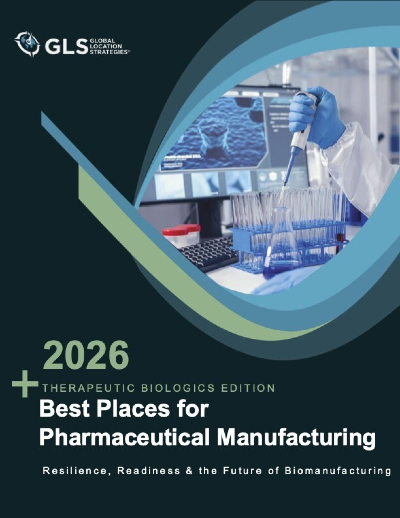
GREENVILLE, S.C. — A $350 billion investment boom in U.S. pharmaceutical manufacturing is being constrained not by cost, but by a shortage of skilled labor, according to a new report from Global Location Strategies (GLS). The firm’s 2026 Best Places for Pharmaceutical Manufacturing Insights Report highlights the key factors shaping investment in the country’s therapeutic biologics industry amid a broader “Reindustrialize America” movement.
GLS: Staff shortages, tariffs threaten $350b U.S. pharma investment boom
The GLS analysis identifies Raleigh, North Carolina, and Salt Lake City, Utah, as the top two U.S. metropolitan regions with the most potent combination of quality factors critical to biologics manufacturing and competitive operating costs. The report emphasizes that as the United States continues to pursue domestic reindustrialization, a robust pharmaceutical manufacturing base is crucial to national defense—ensuring secure access to critical medicines, vaccines, and biologics necessary for military readiness and emergency response.
“The amount of investment across the U.S. biologics industry is encouraging to see, but it’s only sustainable if we invest as much in people as we do in plants,” said Didi Caldwell, president and CEO of Global Location Strategies. “Workforce readiness is now the true competitive edge. Our ability to respond to skilled labor shortages will determine where investment goes from here. Building where the talent pool meets innovation and resilience is how the U.S. will continue to thrive.”
According to GLS, the global biologics market is projected to grow at a 10.5% annual rate from 2025 to 2035, outpacing traditional pharmaceuticals. The U.S. continues to lead the world in biologics revenues, accounting for nearly half of the global market. Therapeutic biologics—including monoclonal antibodies, recombinant proteins, gene and cell therapies, and therapeutic vaccines—are among the fastest-growing segments of the international medical industry, transforming treatment for cancer, autoimmune disorders, and rare genetic diseases.
The U.S. remains the global anchor of biologics manufacturing, with 90% of the world’s 6,000 FDA-registered facilities located domestically. However, despite heavy domestic manufacturing activity, 91% of biologics sold in the U.S. are imported, reflecting a deep global interdependence even amid a push for reshoring and supply-chain resilience.
The report notes that the U.S. is now in one of the largest biopharma investment waves in decades, with more than $350 billion in announced spending by 2030 across manufacturing, R&D, and supply chain functions. Significant investments include Eli Lilly ($5 billion, Goochland County, Va.), AstraZeneca ($4.5 billion, Albemarle County, Va.), Biogen ($2 billion, Durham, N.C.), Johnson & Johnson ($2 billion, N.C.), and Merck & Co. ($1 billion, Wilmington, Del.).
Policy changes are further reshaping the landscape. A 100% tariff on branded and patented drug imports, effective October 2025, is designed to incentivize domestic production. The report notes that the policy “has already triggered new long-term investments from AstraZeneca ($50B), Johnson & Johnson ($55B), GSK ($30B), and Eli Lilly ($11.5B).” Exemptions are in place for companies making substantial investments in U.S. manufacturing.
These shifts, combined with rising FDA scrutiny of foreign plants—only 6% of which were inspected in 2022—are pushing multinational firms to bring production closer to U.S. soil. GLS adds that pricing pressures remain acute: branded drugs represent only 7% of prescriptions yet account for 87% of total drug spending, prompting policymakers to link reshoring efforts with price stabilization.
Workforce challenges continue to dominate the investment landscape. The biologics industry employs approximately 46,000 workers and is expanding at a rate of 5.1% annually; however, nearly 60,000 positions remain unfilled, particularly in GMP operations and process validation. Average wages have increased almost 10% over the past five years to $127,000, reflecting the intense competition for specialized talent. Escalating H-1B visa costs and restrictions have also slowed the influx of international expertise, tightening an already scarce labor market and influencing where new facilities can viably establish themselves.
To sustain growth, GLS recommends a dual-track workforce strategy—expanding domestic training programs while reopening targeted visa pathways for international specialists. The report urges state and regional partners to “scale bioprocessing and GMP programs, build apprenticeships, and strengthen university-industry pipelines that lead directly to employment.”
“This two-pronged approach is essential for site selectors and investors looking to ensure that the U.S. biologics boom remains both scalable and sustainable,” the report concludes.
The report ranks the top five metropolitan areas for therapeutic biologics manufacturing as:
- Raleigh–Cary, N.C.
- Salt Lake City–Murray, Utah
- Durham–Chapel Hill, N.C.
- Philadelphia–Camden–Wilmington, Pa.–N.J.–Del.–Md.
- Indianapolis–Carmel–Greenwood, Ind.
GLS also identified Cincinnati, Ohio, and St. Louis, Missouri, as fast-rising contenders due to affordable industrial land and expanding talent pipelines.
The findings, GLS said, position U.S. biologics manufacturing as a strategic national asset vital to both public health and economic independence.
For more information or to access the full report, visit globallocationstrategies.com.