This is the third article in a three-part series covering results of a study conducted by Persuadable Research Corp. in February.

By Megan Moyer
For manufacturers who are addressing women’s health at any point during a woman’s lifetime, it’s essential to understand the mindset and potential misinformation and frustration that might already exist surrounding the symptoms and stage she’s in. Marketing and messaging must hit the mark to ensure you attract rather than repel consumers and help women confidently navigate each life stage. Reviewing or conducting research to understand your target and providing more than item features and benefits will go a long way to driving shoppers to your brand and your retailer partners.
This is the final article in a series exploring the women’s health opportunity overall, and through the lens of how retailers, and now manufacturers, can take action to address the gaps in information, support, and education.
Insights from Persuadable Research Corp.’s Women’s Health Series research of 750 women aged 35-65 from early 2026 shed light on the mindset of women who are in perimenopause or menopause — women are largely unprepared for both. Fifty-seven percent said they are “not very” or “not at all” prepared, while only 9% said they are “extremely” or “very” prepared. Just over a third of respondents claimed they did nothing to prepare.
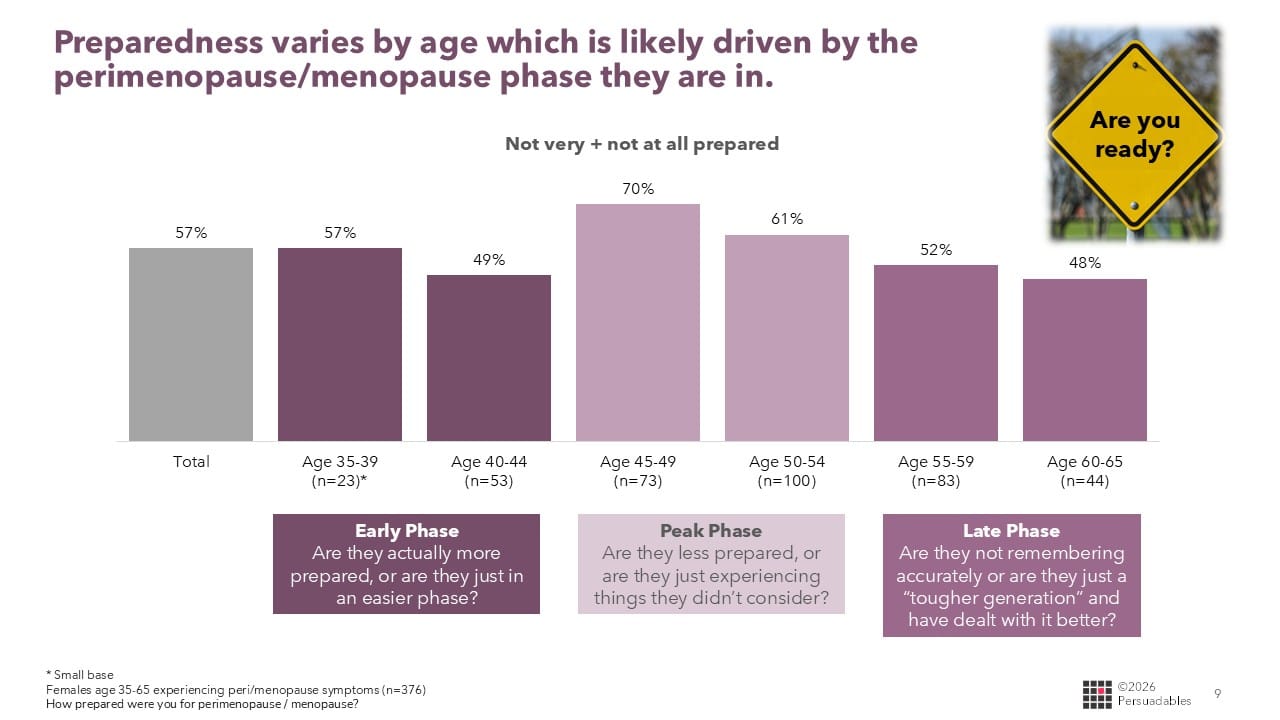
A closer look showed preparedness varied by age group, likely related to the phase of peri/menopause the woman was experiencing. (see graphic slide above). Of those in their late-30s and early-40s, about 50% were not very prepared or not at all prepared; those in their mid-40s to mid-50s were in the 60%-70% range; and those in their mid-50s to mid-60s were around 50%. Persuadable Research questioned whether:
• The younger group was actually more prepared or just in an easier phase,
• The middle group was indeed less prepared or just experiencing unexpected symptoms.
• The older group wasn’t remembering what they went through or were just a “tougher generation” and dealt with it better.
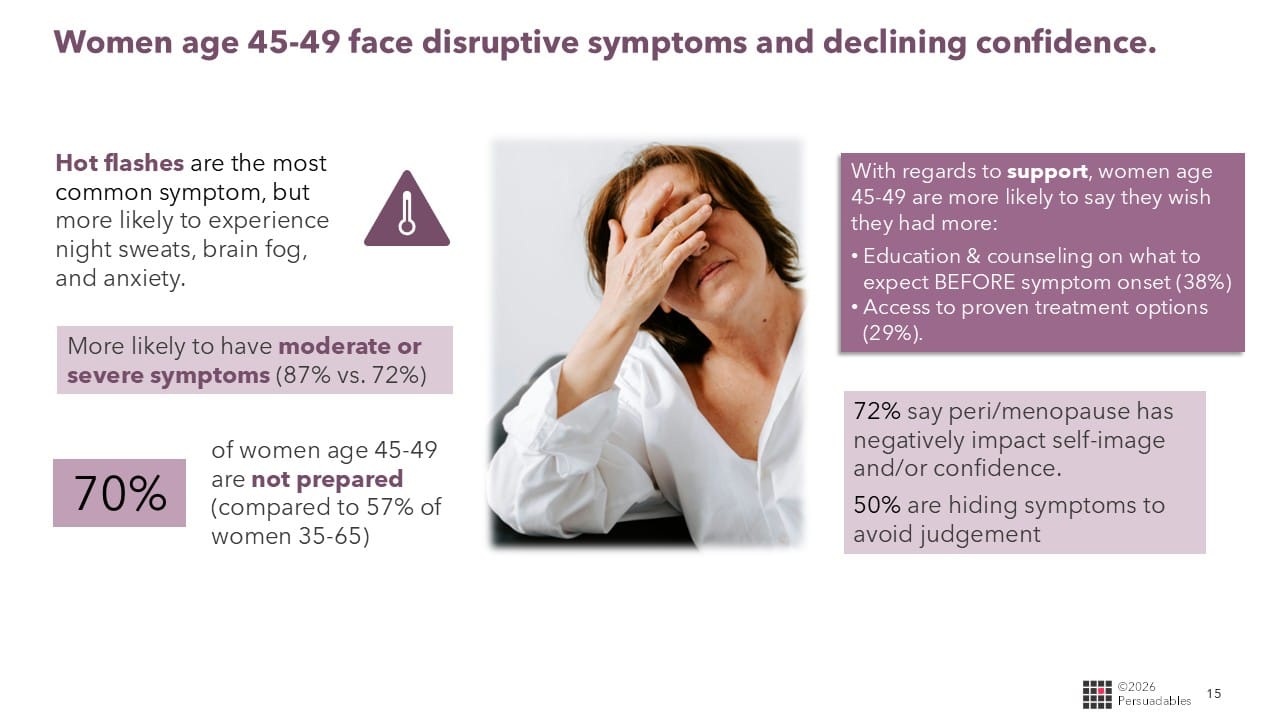
In fact, it was established that women aged 45-49 face disruptive symptoms and declining confidence and are more likely to have moderate or severe symptoms (87% vs. 72%) (see slide above).
If you’ve read the previous two articles in this series, the overall takeaway from Persuadable Research is that more needs to be done to help women navigate the peri/menopause stages of life. They feel unprepared, unsupported, and unaware of all the potential symptoms and available treatment options. We offered ideas for retailers in the previous article, but manufacturers have an opportunity to ally with this group of women more directly. Erika Herrin, president of Persuadable Research, said, “Based on what we heard from survey respondents, there are several things brands can do to stand out:
• Offer realistic, effective treatment options to address top symptoms.
• In marketing material, embrace changes as a positive to address waning confidence.
• Provide educational materials.
• Provide testimonials, reviews, and clinical proof to overcome treatment skepticism.
Anything you can offer that helps women feel more prepared for peri/menopause will increase loyalty in this segment. Having insight into what may be ahead, solutions available and options for treatment can make a significant difference in the mindset and outlook of women who will inevitably be dealing with some set of symptoms. For a group that feels unsupported, sometimes unseen, and often doesn’t know where to turn for answers, your brand could establish itself as a source of support in addition to the solutions you provide.
Herrin’s suggestion to offer educational materials is key. Providing reliable information is a smart step, whether it’s about your product, what it treats, related research, or clinical studies if available.
If you have the resources, fostering a community where women can share knowledge and experiences is another option that can build your audience. Giving women a platform to learn from and relate to one another will build goodwill and encourage loyalty to your brand.
An important point to remember is that your messaging should be considerate of how women in these stages of life may be feeling about themselves and what they are battling. As Herrin noted, embrace positivity. Acknowledging the struggles and difficulty of finding solutions that work and advocating optimism will attract women looking for hope in a challenging time. After decades of little acknowledgment of these significant life phases, honesty and frankness will be appreciated.
If you build a community, it will be an excellent resource for participants, and you can also benefit from seeing firsthand what they’re experiencing, their concerns, and the outages they identify. Another option is to seek the most current market research.
You can take multiple approaches to become an ally to these segments of women. Your path should align with the solutions you offer and your brand, of course, but if you can go beyond talking only about your products to show interest in offering overall support, you will find customers who appreciate the extra effort.
Megan Moyer is a 30-year retail industry veteran and HRG’s corporate marketing manager. HRG supports retail decision-making by working with product manufacturers, distributors, retailers, technology partners, and other industry organizations to provide data and analysis, shopper experience, brand development, fixture coordination, and retail communications solutions.
Persuadable Research Corp. partners closely with brands and agencies across a wide range of product categories and industries, bringing the consumer’s voice into clients’ decision-making through custom quantitative and qualitative marketing research, advanced analytics and proven research techniques.
Submit Your Press Release
Have news to share? Send us your press releases and announcements.
Send Press Release