WASHINGTON – A new national voter survey commissioned by Plan B One-Step shines a spotlight on a women's health care crisis that is hitting hardest in America's rural communities. The survey, conducted by Impact Research and Echelon Insights for Center Forward among 1,206 registered voters in the likely electorate nationwide, reveals that rural women face steeper barriers to quality health care than any other group examined, and that voters across the country recognize and are troubled by this disparity.
"For a woman living in a rural community, access to over-the-counter emergency contraception can make all the difference," said Tara Evans, Marketing for Plan B. "She may not have a clinic nearby. She may not be able to get an appointment quickly. Plan B being available over the counter, right there on the shelf, is not a convenience. For many rural women it is their only option. This data reminds us exactly why protecting that access is so critical."
At a time when rural hospital closures, provider shortages, and limited pharmacy access are already straining health care options in America's heartland, the data makes clear that rural women cannot afford further restrictions on the health care tools they rely on, including over-the-counter emergency contraception.
KEY FINDINGS ON RURAL WOMEN'S HEALTH CARE:
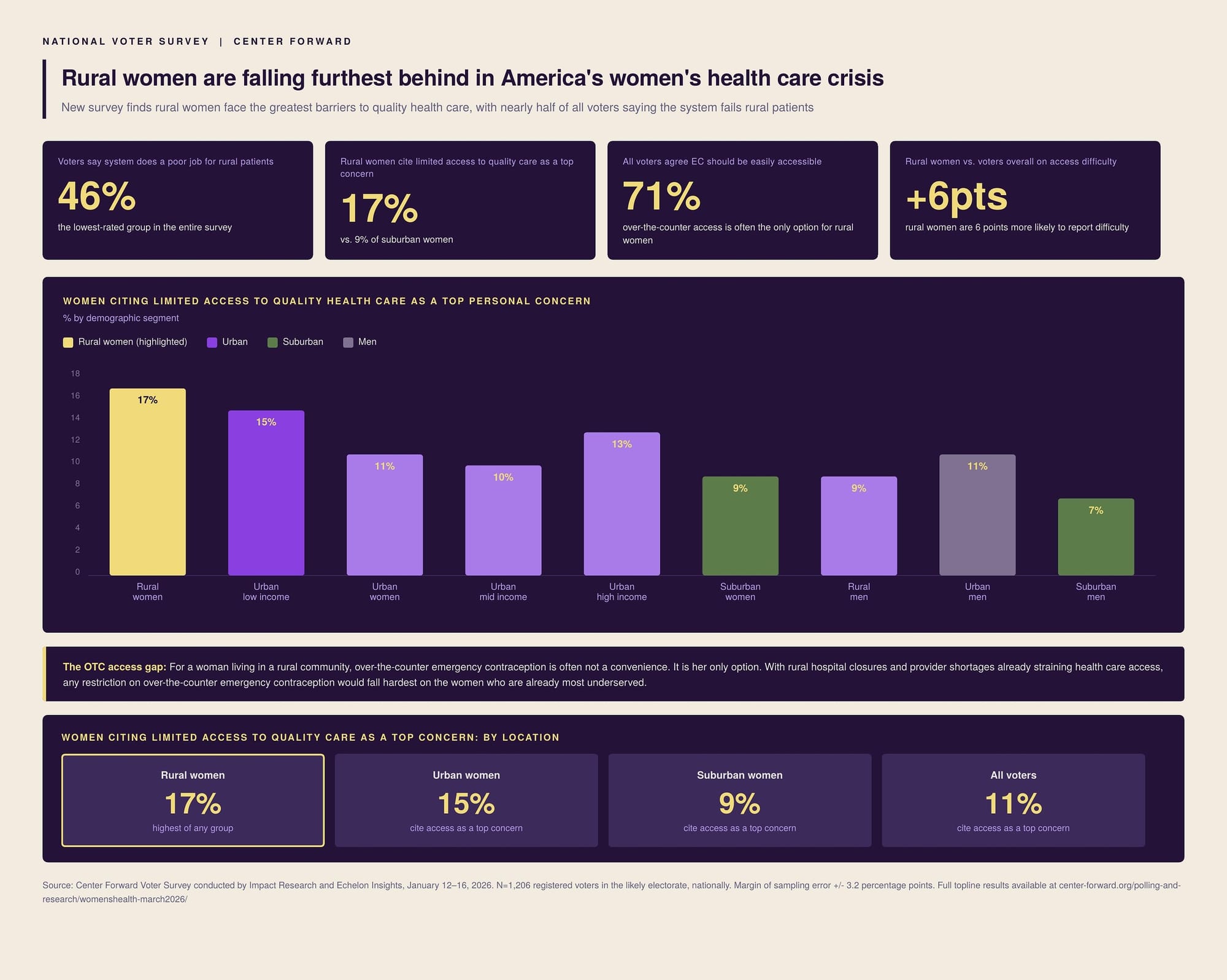
- 45% of all voters say the U.S. health care system does a poor or very poor job meeting the needs of rural patients, making rural health care the lowest-rated category in the entire survey.
- Rural women are 6 points more likely than voters overall to say they have a hard time finding quality health care, with 17% of rural women citing limited access to quality care as one of their biggest personal health care concerns.
- Rural women report significantly greater difficulty accessing health care than their urban and suburban counterparts, with urban women at 15% and suburban women at just 9% citing access as a top personal concern.
- 92% of all voters agree that women have unique health needs deserving specific care and attention, a finding that holds across rural, suburban, and urban communities.
- More than 8-in-10 voters across all genders say it is very or somewhat important for policymakers to ensure women have access to gynecological care, prenatal care, postpartum care, and over-the-counter emergency contraception.
- 71% of all voters say it should be easy for women to access over-the-counter emergency contraception, a figure that reflects the reality that for rural women, over-the-counter availability is often the difference between having access and having none.
- 76% of voters believe emergency contraception should remain over the counter and accessible like other over-the-counter medications.
The rural health care gap documented in this survey is not just a women's issue. It is an equity issue. Voters earning under $50,000 annually, a demographic that skews rural, are among the most likely to feel that the health care system does not pay enough attention to their needs. For these communities, over-the-counter access to emergency contraception represents one of the few health care tools that does not require an appointment, a referral, or a long drive.
"Rural women deserve the same access to reproductive health care as women anywhere else in this country," adds Evans. "Plan B is committed to making sure that no matter where a woman lives, she has the tools she needs to make decisions about her own health."
The survey was conducted January 12-16, 2026, with a margin of sampling error of plus or minus 3.2 percentage points. Full topline results are available at center-forward.org.