
By Wendy Liebmann
For the last couple of years, the topic on everyone’s minds — no doubt yours — has been artificial intelligence. We’ve moved so quickly from the era of Big Data and “I’ll Google that” to discussion of large language models and how fast new open-source technology would enable industries of all kinds to process information. Conversations quickly shifted to cost savings, profitability and implications for jobs (which ones would survive and which ones would not).

In a matter of months, we learned an entirely new vernacular. (I actually used Perplexity to create an AI glossary because it was all changing so fast.) Often our regular conversations with clients about how to build strategies to engage more loyal shoppers now veer off to include questions about “What is your AI strategy?” “Are you investing?” “How much?” “How are you measuring the impact?” … and more. (Sound familiar?)
But here’s something you may not know: While business is moving madly to invest (a lot) to build AI tools, the people who buy our goods and services are not frantically jumping into the fray … at least not yet. That’s what we learned in our latest How America Shops with AI research, an in-depth study of the AI shopping experience.
Technology’s Impact on Shopping
WSL Strategic Retail has been studying technology’s impact on people’s purchasing habits for decades. We’ve studied everything from TV shopping and infomercials, to online and app-based shopping, to the current social shopping landscape. And so off we went to understand the potential role of AI.
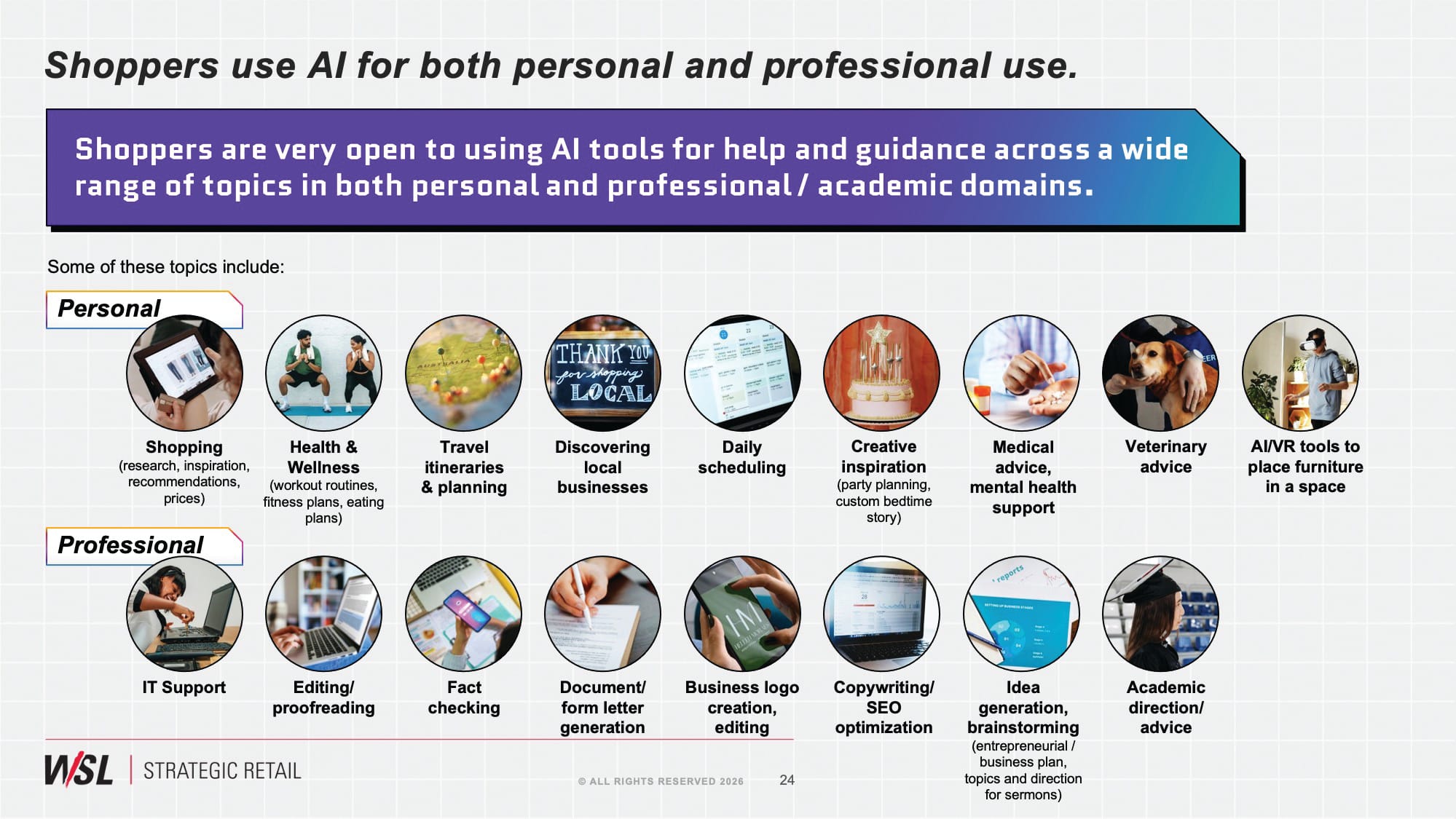
While there are already quantified surveys (some even free) on who is using AI to buy, how and what, we wanted to do a deeper dive into the psyche of “progenitors” of the new AI shopping experience. We conducted in-depth one-on-one interviews with individuals who had used AI in their purchase journey in the last three months. We sat down with people across generations, lifestyles and backgrounds to understand how they use AI in their everyday lives and shopping today, what they saw as the barriers and opportunities of these new tools, and the implications for categories and retailers now and in the future.
An Evolution Not a Revolution
Here are some highlights:
• AI today is just one more tool in the shopper’s toolkit. AI isn’t changing everything, but it can make many things easier. It is changing the vernacular of shopping and how brands and retailers need to connect with shoppers. But it is still only one part of the process. It’s not replacing everything. (And won’t.)
• AI democratizes information — making it easier, faster to find answers shoppers want and need. It gives them greater control. And, as our How America Shops in Chaos study revealed, shoppers want (demand) control more than ever in these chaotic times.
• The conversational tone of AI makes usage intuitive — and it eventually feels personalized.
• Shoppers are learning how to use AI and, even more importantly, how/if/when to trust it. “Trust but verify” is their modus operandi.
• Retailer agents like Rufus and Sparky are not trusted. Most aren’t even aware of them. Interviewees were concerned that they would be biased. The assumption is that these agents would only push what the retailer sells — not broader, more objective recommendations.
One thing is clear from our interviews: AI will change shopper expectations of the overall in-store and digital shopping experience. This is just the beginning.
Things to consider now. Questions you need to answer fast:
1. The shopper’s journey may be starting somewhere you are not. Discovery is happening before shoppers even land on your website or walk into your store. Your competitive set may change — and fast. Does your strategy assume you’re already in consideration?
2. Speed is resetting shopper expectations — everywhere they shop. Shoppers who use AI arrive at every touchpoint more informed and — maybe — more demanding. Is your experience built for shoppers who have already done their homework?
3. Trust is the real differentiator — some AI tools start at a disadvantage. Shoppers like that AI feels objective and unbiased. Unlike retailer-owned AI. Do you know what shoppers are using, and may, before you decide where to invest first?
4. Not all categories are equally at risk — or equally ready. AI is disrupting some categories faster than others. Do you know where your category really stands? Now? And in the future?
For answers to these questions, and more, our full study, including video clips from the interviewees, is available for purchase at wslstrategicretail.com. And, as always, we are here to guide you.
In the end … AI is already reshaping the purchase journey, but it is not replacing anything, yet. As we look back to how people adopted e-commerce or, more recently, social shopping, it’s apparent that AI is just one more tool they’re willing to use if it enables them to make their life easier, puts them more in control and, ultimately, if it solves “jobs to be done.”
So put the shopper in the center of your AI investment decision making and you’ll come closer to solving the AI conundrum, fast.
Wendy Liebmann is CEO and Chief Shopper of WSL Strategic Retail, a global retail strategy and shopper insights consultancy, publisher of How America Shops, Shopping Life, and the Future Shop podcast.