NEW YORK — Walmart and Google are taking their partnership to a new level, unveiling an agent-led commerce experience that embeds Walmart and Sam’s Club shopping directly into Google’s Gemini platform — a move executives say marks a fundamental shift in how consumers will discover, plan and purchase products.
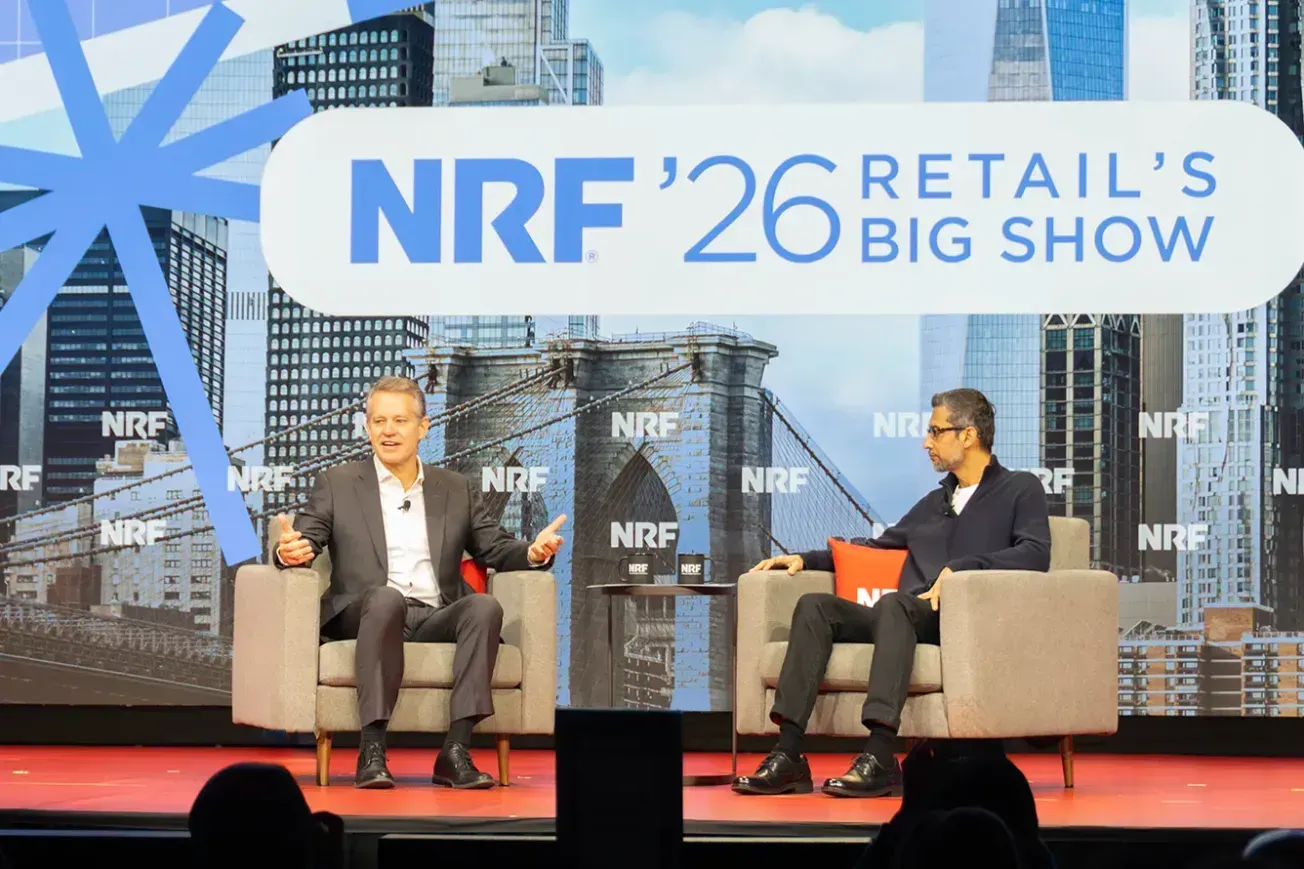
The announcement came Sunday at the National Retail Federation’s “Big Show,” where Sundar Pichai, CEO of Google and Alphabet, joined John Furner, Walmart’s incoming CEO, on stage to discuss the retailer’s transformation and the role artificial intelligence will play in its future.
Furner, a 32-year Walmart veteran, framed the moment as both a continuation of the company’s purpose and a willingness to radically rethink everything else.
“Retail was different in 1993. There was a playbook on how it worked and things seemed familiar at that time,” Furner said. “But in these last few years, we are in a different period. What won’t change is our purpose, our values, the way we think about people leading. But everything else we are willing to change — what we sell, how we interact with customers and with our associates.”
That mindset is now translating into what Furner called a rewrite of the retail playbook, powered by agentic AI — a network of specialized AI “agents” designed to support customers, associates, sellers, suppliers and developers.
At the center of the strategy is Walmart’s customer-facing AI agent, known internally as “Sparky,” which helps shoppers gather information and create solutions. Inside stores, associates use a separate agent on handheld devices that guides them to the “best next action,” helping prioritize tasks, support customers and manage their teams in real time. Additional agents support marketplace sellers and suppliers by helping them list products and build campaigns, while a developer agent assists Walmart’s technology teams.
“All this put together, it’s helping us understand how to meet people where they are and anticipate how they live,” Furner said. “For us, agentic AI is an exciting unlock. This is really significant just as search was for e-commerce a few years ago.”
The most visible expression of that strategy is the new integration with Google Gemini. Through the partnership, Walmart and Sam’s Club assortments, pricing and availability will be embedded directly into Gemini, allowing users to plan purchases, build carts and complete transactions within the AI experience.
“Today we are announcing an agent-led commerce experience built by Walmart within Google Gemini,” Furner said. “Gemini will automatically include our assortment, our prices, help customers understand what’s available, and then pair the intelligence of Gemini with our catalog, our experience and our pricing.”
Customers will also be able to link their Walmart accounts with Gemini, enabling the platform to reference past purchases and shopping behavior to recommend next steps.
For Furner, the goal is to close what he called the gap between “I want it” and “I have it” — reducing friction in everything from discovery to fulfillment.
“The future is very personalized. It will be very convenient and it will be high speed,” he said.
He illustrated the potential with a scenario: a customer planning a fishing trip to Northwest Arkansas could ask Gemini for help, and the system would factor in weather, location, past purchases and items already in the Walmart app cart to build a complete shopping solution — with gear and groceries delivered to a hotel upon arrival.
“These kinds of experiences we think will be great for our customers,” Furner said. “We know their time is precious, and our purpose to save people money and live better has a big element of helping people save time.”
Pichai, who noted the parallel transformations both companies have undergone, said the collaboration reflects how AI is reshaping commerce in real time.
The integration positions Walmart at the forefront of what many in the industry are calling the next wave of digital retail — one driven less by search and clicks and more by proactive, conversational and contextual engagement.
As Furner put it, “We’re building and we’re partnering. And we’re excited about both. We’re at this point rewriting the retail playbook.”
For Walmart, the message from the NRF stage was clear: the company’s next chapter will be defined not just by scale, but by speed, personalization and the power of intelligent agents guiding every step of the shopping journey.