By Wendy Liebmann
Amidst all the upheaval of the last two decades, there has been one constant, the unfailing ability of people — shoppers — to learn to adapt to the chaos.

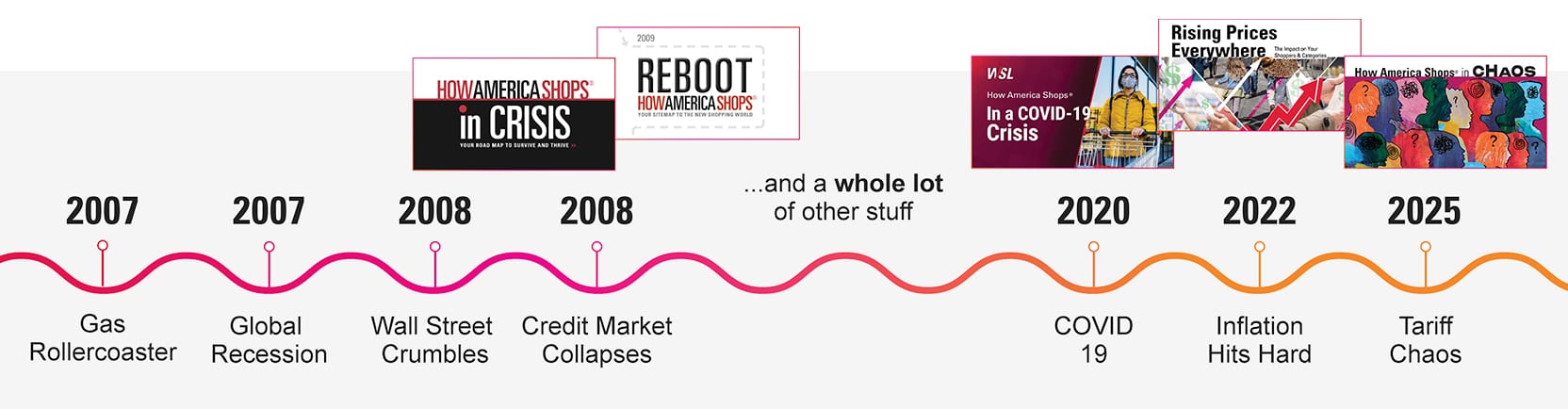
I’m a great believer in the value of context, looking back to look forward. So, in preparation for WSL’s upcoming “How America Shops in Chaos” study, we dug deep into our data archives to understand how the current economic chaos differed from 2008 (the Great Recession), 2020 (the COVID-19 pandemic) and 2024 (prolonged inflation). What was clear from our data was that many shoppers have never stopped being fiscally cautious. They’ve simply grown adept at disciplined spending when they need to be.
Adapting to economic
uncertainty can be like
riding a bike
Yes, consumers have proven they can adjust quickly to economic uncertainty, just like remembering how to ride a bike. However, for millions of Americans that doesn’t make it an easy ride.
Following are some significant takeaways that foretell what to expect in 2025 and serve as context for our “How America Shops in Chaos” study, coming soon.
Findings from our 2008
‘How America Shops in
Crisis’ report
The Great Recession of 2008 marked the worst economic crisis since the Great Depression, culminating nearly eight years of uncertainty marked by the dot.com crash, the September 11 attacks, tighter credit access thanks to the sub-prime mortgage debacle and record-high fuel prices (the list goes on).
Consumer confidence sunk as shoppers contended with higher costs for mortgages, groceries, utilities and fuel. (Sound familiar?) Our “How America Shop in Crisis” national study captured how shoppers reassessed the meaning of value at the time.

Key takeaways that you should bookmark in 2025:
• Optimism dropped — further: Less than one in three felt their finances would improve annually, down from 2007. Concern over job loss doubled.
• Cautionary spending rose: Nearly 70% of all shoppers said they were more careful about shopping in 2008 than in 2007. A higher share said it was important to get the lowest prices on most things — up roughly 18 percentage points from 2007.
• Most shoppers bought less: Two-thirds cut back on spending due to economic uncertainty. Even more did not want to shop for anything they didn’t need.
• National brands fell from favor: More than half of all shoppers said they were more likely to switch to lower-priced brands (including store brands).
• Retail trust eroded: Shoppers actually relied more on website reviews from total strangers than from store associates. They trusted friends, family and themselves most.
• Caring became an essential value: The top 3 attributes shoppers picked for an enjoyable retailer were customer service, a well-trained staff and being treated like their business was valued. Preferences for earth-friendly goods also climbed.
Shoppers bounced back
from the recession, until COVID-19
When COVID-19 closed down our lives in March 2020, the shopper’s cautionary spending reflexes were still twitching and proved surprisingly adaptable.
In our 2020 “How America Shops in a COVID-19 Crisis” study, we saw:
• Sinking optimism returned: Consumers’ financial security remained low in 2020, and it continued to limp along in 2024. (And, in a preview of our new study … still does.)
• Smart spending returned as well: Most shoppers cut back on spending in 2020 and asked, “Is this a smart use of my money?” One-third said they avoided stores and websites where they felt tempted to buy.
• Sales and stock-ups prevailed: Most shoppers were loath to pay full price for items, waiting instead for them to go on sale and then stock up.
• National brands continued to lose favor: Shoppers traded down to less expensive brands in order to save money and liked the results. In 2024, more than half of all shoppers switched brands because prices were too high, and “shrinkflation” became a dirty word.
• Online shopping expanded: Even with retail stores open for business, most consumers shopped online for key categories. This contributed to the shop online/pickup at store option so popular now.
• “Caring” became the price of entry for retail: Shoppers put very high value on how much retailers cared about them in 2020. Yet half or fewer felt that retailers — from supermarket to online retailers — cared. In 2024, that didn’t improve much.
2025 … What’s worth it now?
As we begin to analyze the data from our new “How America Shops in Chaos” study, what’s clear are several things: Shoppers have remained, for the most part, financially cautious. And this continued habit of thriftiness is reinforcing a set of rules for brands and retailers:
• Recognize their new values as shoppers. Price is persuasive, but brands and retailers can gain an edge by sharing new shopper values, such as showing care for their well-being (for example, making shopping easier) and being good citizens. If not, your shoppers will quickly drop one brand or retailer for another that caters to their values.
• Help consumers feel they are being responsible. Since 2008, consumers’ need to feel smarter and more responsible, not guilty, about what they buy has grown more acute. This impulse remains and is gaining influence. Customers who feel understood, valued and smart about where they spend are likely to be more loyal to that outlet.
• Don’t squander their trust. In 2008, just one in five customers was likely to trust the information brands and retailers provided. In 2024, that figure escalated, depending on the retailer. Retailers can use their store brands to communicate the values important to shoppers today, including sustainability, healthy ingredients, quality and price. National brands can do the same.
• Find a way to be everywhere. Shoppers are buying in-store, online, in an app — sometimes all at once. A retailer or brand might not be able — or choose to — step into all these paths at once, but they can seek opportunities in lower-cost cobranding partnerships and pop-up events that keep them top of mind.
Be prepared for how Americans shop in times of chaos.
What’s clear in looking back to look forward, American shoppers have been through this — or something similar — before. They are smart; they have learned how to adapt. And they have many tools — old and new — to help them. Our call to action is to recognize that before many shoppers (regardless of age or income) spend anything today they ask themselves is it worth it.
Wendy Liebmann is the chief executive officer and chief shopper of WSL Strategic Retail.