In written Chinese, the word crisis is comprised of two characters that mean “danger” and “turning point” (although the latter is often rendered as “opportunity” in English). The concepts embodied in the ideogram could well be applied to the current state of retail pharmacy. Never has there been a greater need for pharmacy service; never has the industry been under such intense economic pressure.
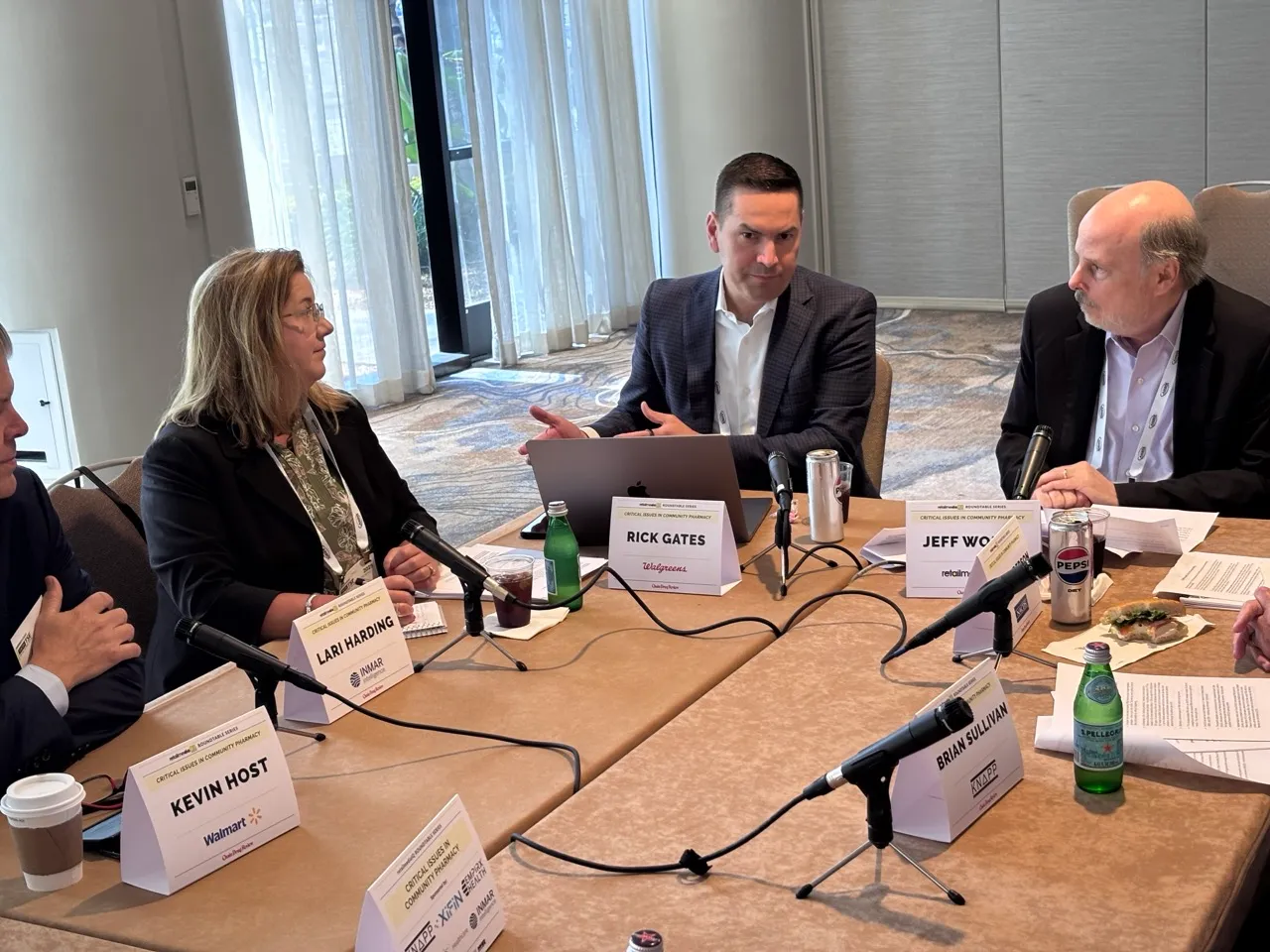
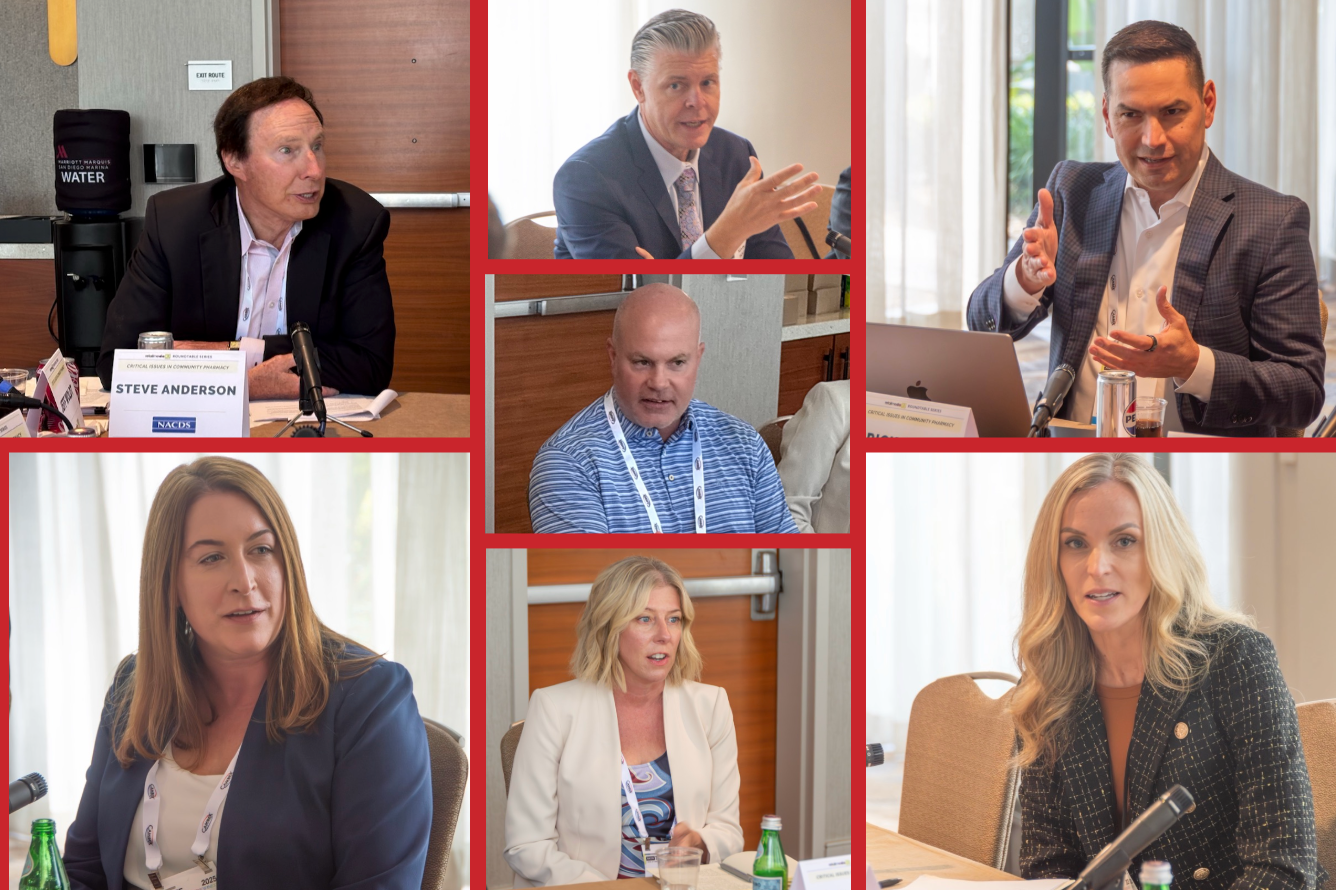
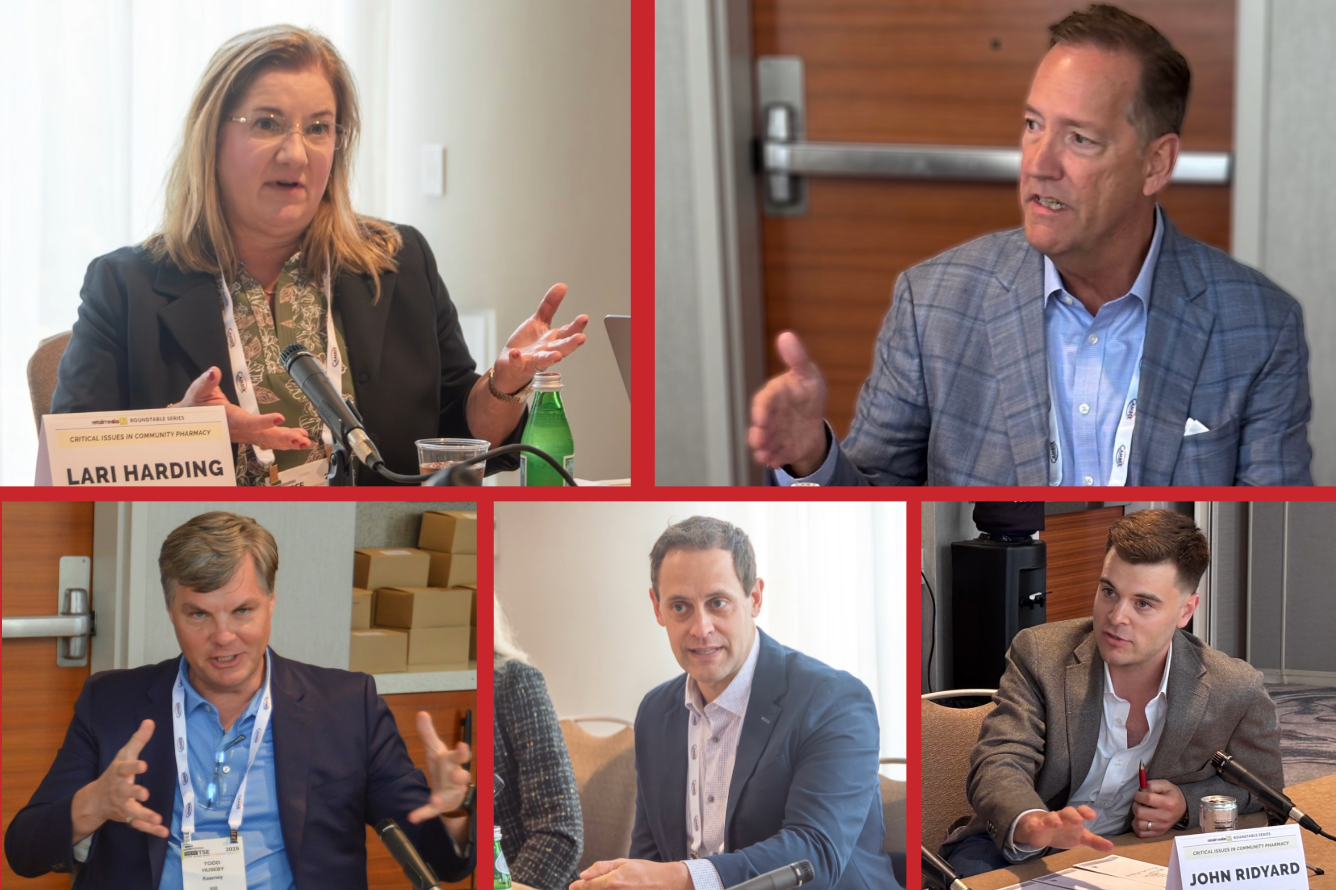
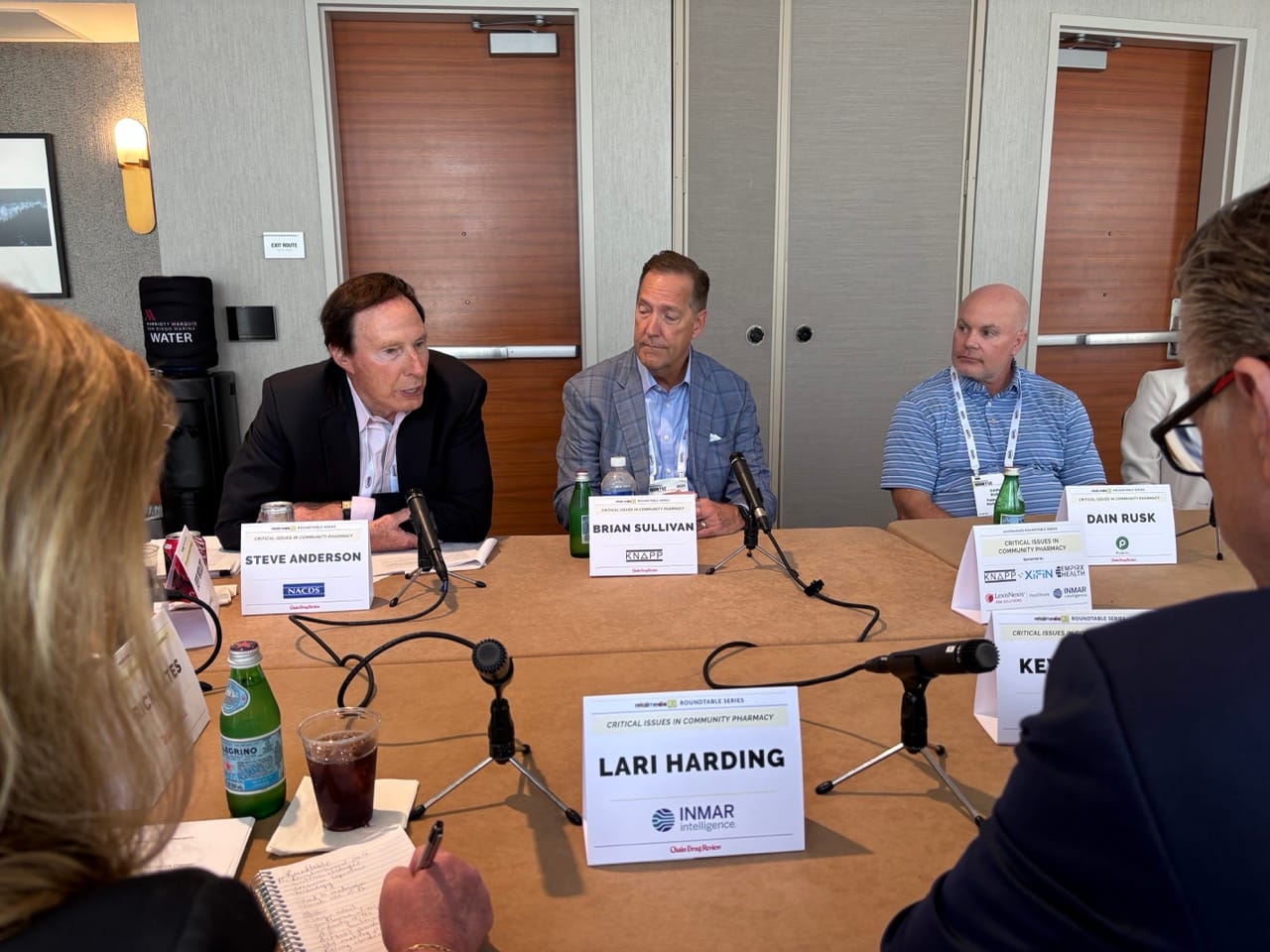
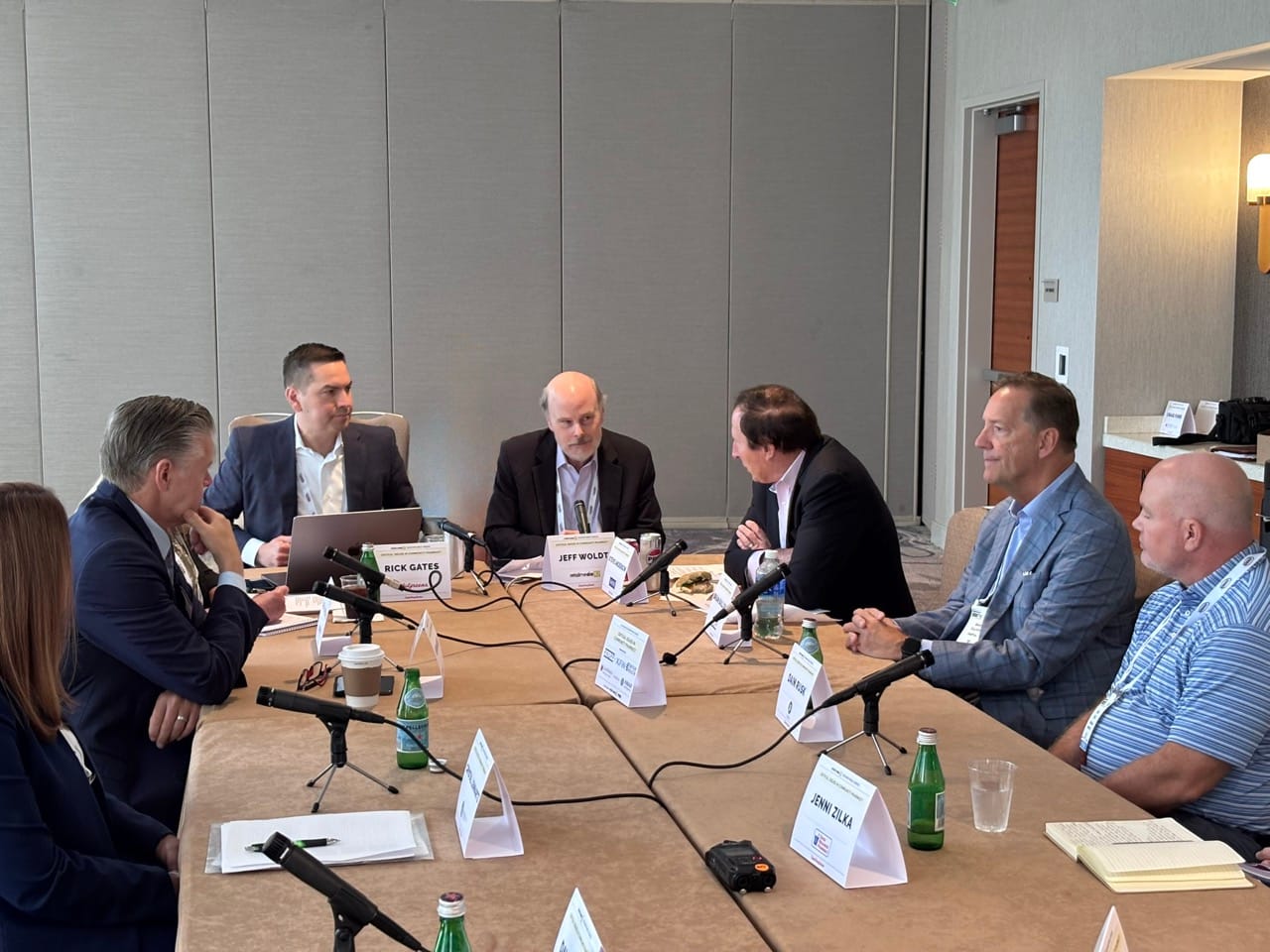
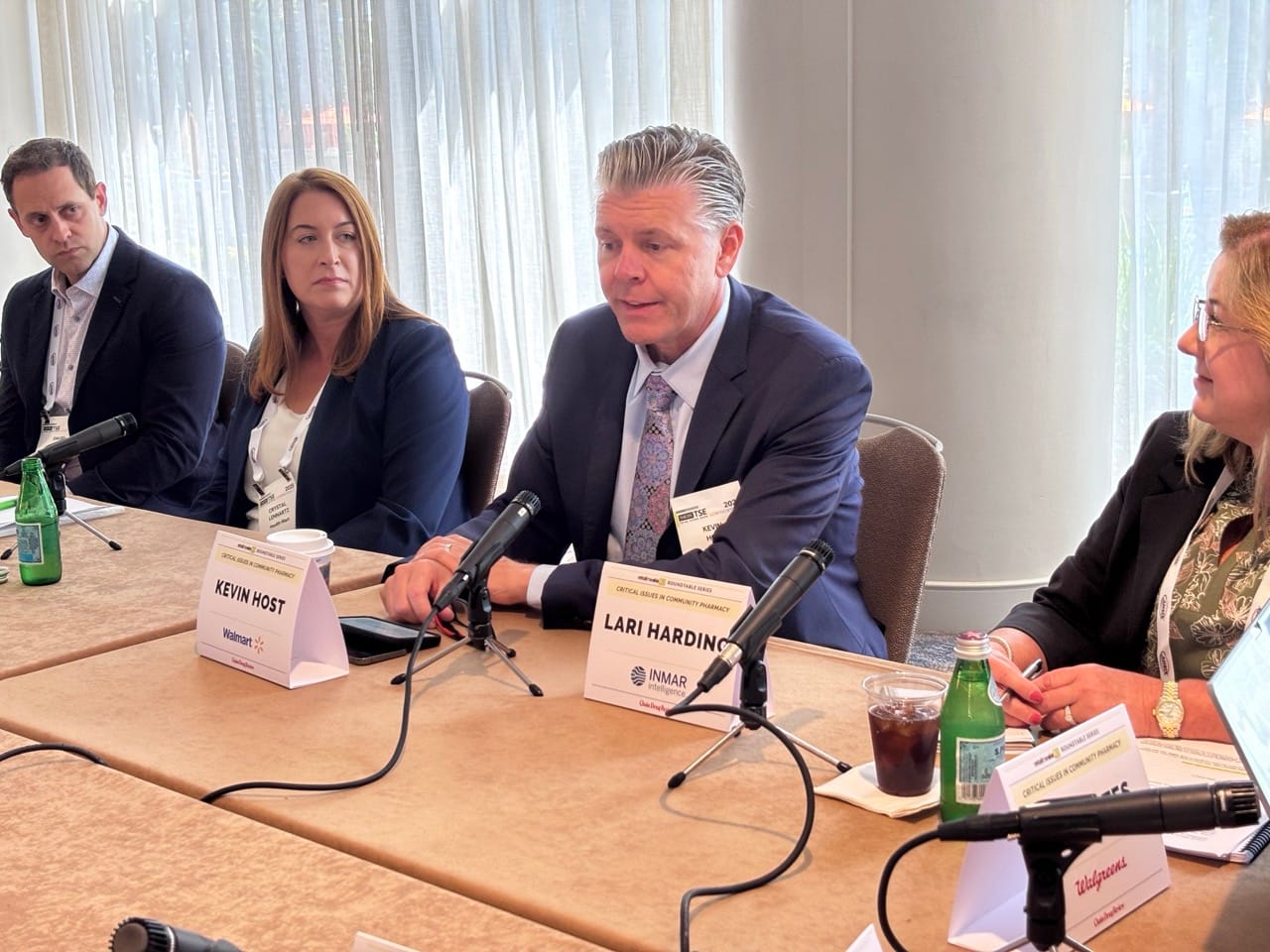
retailmediaIQ recently convened a group of industry leaders to examine the challenges and opportunities faced by pharmacies. A focal point of the discussion — extended excerpts from which follow — was how members of the profession can increase their impact on health care despite anemic reimbursement levels.
Steve Anderson
President and CEONACDS
Rick Gates
Senior Vice President of PharmacyWalgreens
NACDS Chairman
Kevin Host
Senior Vice President of PharmacyWalmart
Crystal Lennartz
PresidentHealth Mart and Health Mart Atlas
Jackie Morse
Group Vice President of Pharmacy and HealthMeijer
Dain Rusk
Vice President of PharmacyPublix
Jenni Zilka
PresidentGood Neighbor Pharmacy
Lari Harding
Senior Vice President of Health Industry Affairsand Strategic Partnerships, Inmar Intelligence
Todd Huseby
PartnerKearney
David Pope
Chief Pharmacy OfficerXiFin Pharmacy Solutions
John Ridyard
PresidentEmpiRx Health
Brian Sullivan
Principal – Pharmacy SolutionsKNAPP
Jeffrey Woldt
Editor-in-ChiefretailmediaIQ
WOLDT: Rick, as NACDS chairman, we’ll ask you to kick off the discussion by giving us an overview of the industry and the challenges and opportunities it faces.
GATES: I’ve been spending my time as NACDS chair trying to listen, getting out there and talking to members, associates and everybody else to understand what’s working, what’s not working and what the challenges are. Everyone from retailers to suppliers to policy makers — I’ve been trying to listen across the board.
One thing is clear. When you think about it, we talk a lot about reimbursement pressure. You’ll hear me talk ad nauseam about that if you want to, but that’s not all we can talk about, because you’ve got a workforce shortage, which is a big challenge for us, and changing consumer experience expectations, as well as technology that continues to change very rapidly.
There are a lot of headwinds for the industry, but there are also opportunities and new ways that we can execute as we go forward. A lot of what we’re all trying to figure out — and this is industrywide, not just for drug stores but for the channel in total, whether it’s going to be grocers, mass or community pharmacies — is how do we evolve the profession in a way that makes sense. How do we really move it forward to deliver care in a different way?
A lot of us are doing it individually, but there are also opportunities for us as an industry to move together. That can be through modernizing our approaches. Some of us are already far down the road on some journeys — whether it’s central fill, microfulfillment sites or centralized services. But there are other opportunities as well, so we all need to look at how we modernize what we’re doing and really elevate the role of the pharmacist. I think the conversation today is really about continuing to move forward with that process.
ANDERSON: This is an interesting time for pharmacy. We’re going to be talking about this a great deal at this meeting because there’s a confluence of events that is allowing us to build, as an association, the industry, the future and what NACDS is going to be all about.
We’ve been doing a lot of work with Surescripts over the years, and we’ve had really some great developments. Together with NCPA [the National Community Pharmacists Association], we started Surescripts in 2001 and merged it in 2008 with RxHub. It’s really become the center of health care in terms of what we’re doing. The Trump administration has announced an initiative where technology is going to play a huge role in health care, and we’ve got a seat at the table.
There’s a lot going on. We have a very activist president. I think everybody would agree with that. There seem to be 10 Donald Trumps all in one day that are running around advancing his agenda. As I have said in the past, I don’t care whether you voted for him or didn’t vote for him, whether you’re far right, far left or anywhere in between. That’s OK with me. I don’t really care about that. What I do care about is your leadership and what you do to convey what this industry does.
We’ve made some really good entrees with the administration, but it gets terribly frustrating with Congress. I’m sure PBM reform will be brought up in much greater detail, but we came really close to achieving our goals in two large bills. PBM reform was done in back in December by political factors that did not even relate to that issue. More recently we had some PBM reform provisions included in the “One Big, Beautiful Bill.” Because of hyperpartisanship, those provisions were among a vast array of provisions that were challenged in the Senate and knocked out by the parliamentarian — again not because of the substance of the provisions but because of politics. We’re still making progress. This is a long, long slog, but it’s important to our members and to all Americans.
We did some really interesting new polling with Morning Consult just this month focused on pharmacy closures and pharmacy deserts, and what the American people think about that. The results are very encouraging from our standpoint. People are concerned about pharmacy closures — just as concerned about the closing of their doctor’s office or nearest hospital. We found that 97% of Americans expect steps to be taken to prevent pharmacy closures. That is encouraging in that it shows people value their pharmacies and pharmacists and expect government to make changes necessary to sustain and advance access. NACDS is a great organization that really works collaboratively and allows us to tell the story of pharmacy and to work on the issues that matter to our members.
WOLDT: Let me ask about PBM reform. That is still the biggest issue facing the industry. What are the prospects for achieving it this year?
ANDERSON: The prospects are promising. The clear message coming from Capitol Hill is that PBM reform remains a top priority, as it has been. Again, we have been on the doorstep to passing and enacting reforms, and the will of the Congress only has been stopped by unrelated political factors. We ask members of Congress what more we can do to achieve this for the American people and for their pharmacies, and they say nothing — they say everything right is being done and it’s a matter of it staying in a larger bill. There needs to be a health care bill. They have physician reimbursement that they have to attend to as well, among other things.
We’ll keep fighting the fight, and we already have a lot of sympathy from members of Congress who are co-sponsors. But we don’t need sympathy — we need enactment of the bill.
WOLDT: Kevin you helped lead the fight last year as NACDS chairman. What’s it going to take to push PBM reform over the finish line?
HOST: We’ve been talking about PBM reform for decades now. The independent pharmacy group has been very vocal. Once upon a time they used to be vocal about NACDS and the pharmacy chains, and now we’re all in the same boat. That is a harbinger of things to come. We’re losing almost four pharmacies a day right now, and it’s because of inaction at the federal level. PBM reform is something that, as Steve mentioned, we’ve got a lot of sympathy and support for, but we cannot seem to find the right vehicles or the right pathways to get it across the finish line.
At the same time, pharmacy is embarking on a new frontier with clinical services. So pharmacists can do a lot more than just fill prescriptions. They can do a lot more than just provide immunizations. We need somebody to increase access to health care, and that’s pharmacies. At Walmart we have nearly 4,600 pharmacies. Four thousand of those are in medically underserved areas. I know many other companies around the table can say the same thing, but not if we’re going to see pharmacies forced to close at the rate that they are.
It’s become painful, and I know the states recognize this and they are even more sensitive to it in a lot of ways, which is why we see dozens, hundreds of bills really get put forward in each legislative session. Many of those get passed, but then you run into practical issues around how to enforce the PBM side versus other things that they need to deal with. All in all, it just leads to not enough activity, not enough completion in terms of reform. So we face the same prospects as we sit here today, and that’s what’s unfortunate.
ANDERSON: One thing I might add is the Federal Trade Commission is still interested, even though we’ve had a change in the administration. Andrew Ferguson is now the chairman, replacing Lina Khan. But there’s a lot of work being done at the FTC with its probe of PBMs. Over the last several months there were three listening sessions, and one was devoted to PBMs, which was encouraging. In fact, it was a joint listening session with the Department of Justice, which adds a whole different component in terms of what might happen. Ferguson was supportive of PBM reform when he was a congressional staff member and as a commissioner before he became chair. There’s still that prospect out there as well. As you know, the president wants to reduce the cost of prescription drugs, and he’s been critical of PBMs being the middlemen. We need action.
WOLDT: Trump has blown hot and cold on this.
ANDERSON: We’re having great conversations with the administration — about the opportunities for NACDS members to help achieve key objectives, and about the challenges and opportunities for pharmacy that need to be addressed to leverage pharmacies. That includes PBM reform. There are good things coming out of what [CMS administrator] Dr. [Mehmet] Oz has said. We’re going to be meeting with him soon to go through some of these issues, continuing what has been productive dialogue to this point.
GATES: Part of the challenge we have with PBM reform is you have the state level and you have the federal level. We’ve got to be more focused on what we’re asking for. Because whether it’s Iowa, Arkansas or any state, what’s coming across as PBM reform is varied.
You have state associations that are driving something different than what’s going to help pharmacy or a state does something that’s good for independent pharmacies but not good for all pharmacy.
That’s one of the things that we have challenges with but, even from a federal perspective, sometimes some of the things that are in a bill don’t actually help pharmacies as much as what we would like. Transparency is great; it’s a great thing to run on. Legislators love that, but actually transparency doesn’t really do much to help us, so we have to be very focused on the things we want — think about rate floors or any one provider. The things that really are going to impact pharmacy is where we have to get to.
WOLDT: Are patients even aware of the threat that PBMs pose to pharmacies? Do they realize that they have a stake in how the issue is resolved?
RUSK: Do patients know? Maybe. I mean, I don’t know that we’re actively trying to educate patients on that point. All they know is they have a health insurance plan and they’re going to take it anywhere and they’re going to pay the same cost.
To piggyback on what Rick said, the biggest challenge right now is state by state. I’ll use Florida as an example. We were happy with the state PBM reform that came through in 2023, but the problem is, without federal reform, the PBMs find what I’ll call loopholes. They reconcile all your business together so they’re compliant with the Florida law on all the commercial plans, but then they reconcile all that business together under one network, which is inclusive of Medicare, so it just makes it look worse.
Without federal reform, without having rate floors, without preventing the offsetting that occurs, you don’t really have PBM reform. To what Kevin and Rick were saying, we’re all out there fighting the fight state by state. Unfortunately, every state has its own version of what matters. None of us really have what I’ll call state-specific PBM plans. We’ve got national plans. You make an impact here and they just squeeze you harder somewhere else. Without federal reform, the state reform is not nearly as significant as it can and should be.
MORSE: Jeff, to your question on “Do patients know they have a stake in this,” I have heard more members of the public talk about PBMs — but it’s so complex. They don’t know the ins and outs, but there is an association with PBMs. People get the middleman concept, but I think that’s as far as it’s gone.
Just to double down on a comment that Dain made, as well as Kevin, I think we’ve got a lot of momentum at the state level. There are hundreds of bills being introduced, and many crossed over the finish line. The two pieces that keep us up at night are the enforcement and the scope. If you close off a couple of tactics, you risk them showing up somewhere else.
WOLDT: Is there a danger that we get state reform — in all 50 states potentially — and have an unworkable patchwork?
RUSK: It’s certainly a possibility, and if that becomes the case I worry about the enforcement of all these disparate laws.
WOLDT: John, first tell us a little bit about your business and then make your point. EmpiRx takes a different approach than the big three PBMs.
RIDYARD: We’re focused on putting pharmacists in the center of care for our patients, ensuring clinically appropriate prescribing. There is enough misalignment in the market that just by doing that — collaborating with physicians prescribing the right drugs for our patients — there’s a lot of savings opportunity.
But specific to the question of state-by-state reform, we would rather invest in innovation to drive the business and care for patients forward as opposed to trying to figure out how to plan for and manage many different state-by-state regulation scenarios.
Perhaps a bit self-serving, but we’re really interested in pushing reform forward, because it helps shine a light on issues in the market that we are aiming to solve. Importantly, if done at the federal level, this PBM reform creates more clarity on how to plan for the future.
We’re probably a little bit less optimistic than some on the likelihood for a timely passing of reform. The challenge is pushing the various players to resubmit, rework, and choose if there is a need to focus efforts or cover all bases. For example, is the priority developing pharmacy-friendly changes or rebate-focused elements that make it into a bill. Ultimately, do you want to do the hard work to determine what’s needed or simply use a word like transparency that’s easy to understand?
GATES: To jump in on that, that’s exactly why I’m always pushing that we shouldn’t be calling it PBM reform. It’s reimbursement reform. There are practices that PBMs do that we can’t do. So, there are absolutely things that are necessary for PBMs. From an innovator perspective, they’re going to think they’re helping advance the profession. That’s not all we’ll be able to do. When you look at it, they have to be very specific things that we’re focused on that are going to have the right impact.
Then we need to work on the ecosystem, because we can’t do this all ourselves. So what you just said is exactly where I was going. I don’t think it’s actually PBM reform, because they’re not all evil. Some do things that aren’t beneficial to the profession and to patients, but I think we just have to be careful with what that is.
RIDYARD: The people working on the political side need to balance that paying pharmacies more is somewhat counter to making drugs cheaper to plans and patients. These things get lumped into PBM reform, but the reality is they are focused on different goals and different stakeholders. We believe, as a PBM, there is room for both fair treatment of pharmacies as well as cost savings to plans and patients, but it requires you to change the conversation from rules focused on unit cost pricing to provide a different service entirely.
WOLDT: Kevin, do you want to comment?
HOST: Well, I was going back to your question. The patients don’t understand this. Dain kind of nailed it. They know they have an insurance company of some sort. They know that they’re hoping for coverage. They’re depending on pharmacies and pharmacists to navigate those coverage decisions. Nobody really truly understands what a PBM does in general, unless you’ve been in one or worked in one.
So there’s a lot of confusion, and I would say that’s evident in the state-level efforts. If the federal government is not going to establish a leadership position with regard to pharmacy reimbursement with sustainability of the drug supply chain, what you’re seeing is that the states will.
ZILKA: I like where you’re headed. As we think about this as an organization with the trade associations, it’s a wonderful time because we’ve all come together — NCPA, NACDS, APHA. The message is consistent, which is amazing. We won’t be successful unless we all do it together. I think we have two opportunities that we’ve touched on, but one is to be really, really clear on what works, whether that’s floors, ceilings or guard rails.
We put so much out there as an industry that, to your point, the legislators don’t understand it and they don’t really know where to start, so they’re trying anything. If we can be really prescriptive in what would help, that would really, truly make a difference.
Then I think amplifying the patient’s voice. We’re kind of sitting here saying patients don’t really know. I have found in meetings with legislators, when we talk about businesses, they say, “Sorry to hear that.” But if we really talk about the access to care and the impact on care and what that means to patients and try to find ways to amplify that voice, I think we could potentially be really effective.
LENNARTZ: From the patient perspective I do think they have an expectation that, coming out of COVID they can receive care in the pharmacy setting. In addition to fair and equitable reimbursement for dispensing, the complement is being reimbursed for services. Product-based reform without the services aspect I think still leaves us in a tough position. Looking for expanded services, whether that be point-of-care testing, patient monitoring or other things … if we’re recognized as providers at the federal level, it will help unlock the potential of pharmacy.
RUSK: Rick has called that out really well. It’s not about putting pills in a bottle anymore. It has to be about value-based care where we’re being reimbursed for the services pharmacists are providing. Technology is going to continue to pull production out of the pharmacy where the teams can then be more customer facing, and I believe most retailers are all headed down that pathway. But the piece that’s still missing right now is the reimbursement side of it, and that’s the part that needs to be fixed for this to be sustainable.
ANDERSON: It all plays into the value of pharmacy at the end of the day. And that’s how we have to address all of the things that are going on right now — whether it’s tariffs, which we’re deeply involved in, vaccine policy or direct-to-consumer sales.
This administration is different than a lot of the administrations that we’ve seen. It’s very unique. It’s very consequential. Whether you’re a Republican or a Democrat, you would say it’s a consequential administration, because they’re taking some really, really big steps. We’ve all said what a disaster health care is. The whole health care system is distressed.
Physician practices are closing and consolidating. Hospitals are closing. When you lose hospitals, you lose emergency rooms. All health care entities are facing lower reimbursement rates, out-of-pocket costs and premiums.
The polling data that we commissioned from Morning Consult is really, really interesting. As I mentioned earlier, 97% of adults feel it is important for steps to be taken to reduce the rate of pharmacy closures in the U.S. . Where do almost 100% of Americans agree on anything? Those are the messages we’re delivering with this new poll. Seventy-five percent of Americans have a favorable opinion of pharmacies; 75% have a favorable impression of their pharmacist. That’s just two points lower than the physician community, which is pretty amazing.
WOLDT: Todd, you’re nodding your head in agreement.
HUSEBY: Well, I love the conversation that’s going on. The thing that’s going through my head in the state-by-state sort of decentralized policy world — Jackie used the word enforcement as she was describing things. The thing I worry about is the local state-by-state level of enforcement, some of which, it seems, at times is politically driven, some of which is just rule-based, what we’re used to accordingly.
I worry at first about this state-by-state level of rules because it does add a lot of compliance costs to every organization. It takes your eye off the ball and puts further pressure on innovation. In addition, if enforcement is uncertain, then it makes it even harder to navigate all of this.
HARDING: There’s an opportunity for us to latch on to some of the things that are very hot right now, like the tariffs and pharmaceuticals as a national security risk. Too much of our supply is manufactured in China and India. We need global diversification of the supply chain. Trump has done a lot of things to really create the market activity to get people to diversify, move to the U.S., and even increase the national reserve of active pharmaceutical ingredients.
These are big moves that we can take advantage of because people understand that pharmaceuticals are a national security issue. If people can’t get their medicines, that’s going to be a problem for Americans.
The next part of that is access. Health and Human Services is investing in this like they would an aircraft carrier to protect Americans. Once we get global diversification, the next thing is really about access. I think we should latch on to the momentum of this movement to advance reimbursement reform so that medicine is available to patients when and where they need it.
WOLDT: David, what’s your view of all these issues that we’ve been discussing?
POPE: I would say as a pharmacist and as a patient with a family, the big thing that we’re focused on right now is access. People worry that there’s going to be a lack of access. However, the good news is that pharmacies have a positive message of how the want to expand access, especially for the rural spaces. We know that when pharmacists get involved in clinical care, they’re seeing patients at a disproportionally higher rate outside of the normal business hours, over the physician’s business hours.
With pharmacies closing at the rate of four per day, at some point folks are going to say, “You know what? I don’t have access to my medications any longer.” We know what happens in America whenever there’s a panic in terms of access.
Crystal, to your point, expanding that access comes with a positive component that says it’s not just so that we can do things the way that we’ve always been doing them. It is a one-two punch. What we’re seeing today in conversations that we’re having — for example, with HHS and RFK’s group — is that there’s a real positive message there. I think that they want to make America healthy, but doing that in the rural space is really hard unless you actually leverage the power of the pharmacist to do that. Unfortunately,we just don’t have the infrastructure. Hospitals are closing on a consistent basis, and disproportionally on the rural segment side. But pharmacies can make a difference, so that’s the message that we’re seeing today.
MORSE: I’ll add one point on the concept of access to services. We now know the voice of the patient, the voice of our communities, is highly compelling. I think we can do a better job as an industry in curating that patient group and really make it central to the access conversation.
WOLDT: You guys pointed out that the Trump administration is making substantial changes, but it seems to me that the process is often chaotic. You talked about some of the positive things that the administration’s done, but consider immunizations. I’m confounded by HHS policy. We have decades of experience that the measles vaccine is going to keep a child healthy and a flu shot is going to keep an elderly person out of the hospital. What should this industry do to counter RFK Jr.’s anti-immunization stance? My view is the industry should do more to encourage people to continue to be immunized.
GATES: I don’t see anyone in the industry not educating consumers about vaccine availability and what they can do. Our pharmacists play a key role in that. When I worked in the stores, customers came to me directly, and I still get calls from my entire family asking what they should do.
Our job is to communicate what’s FDA approved and what goes through the approval process. I just want to make sure we’re not confusing the two. If you ask any pharmacist today, their role is to educate and ensure that consumers know what’s available. Then it’s up to the consumer to make their own decision.
WOLDT: It strikes me that Kennedy is undermining confidence in immunizations, and the president seems to have given him a free hand at this point.
ANDERSON: Everybody in the administration has a free hand. So they have these broad parameters, and that’s why it’s so different than other administrations. You could always go in and plead your case. We went in, as an example, to talk about tariffs.
We don’t know where this Section 232 investigation on pharmaceutical tariffs is going to go. But there’s going to be a 15% tariff on branded products in the United States from the EU. Generics, which is what we wanted, has a zero tariff, which is good, but that doesn’t extrapolate.
It’s sort of like there’s this concept of Make America Healthy Again and there are different parameters on how you do this. I made the case personally to Dr. Oz that this is how you Make America Healthy Again — with pharmacists. You’ve got the biggest asset right there, and most of these health care crises are in rural areas.
There’s a pull. It’s not only finesse, but it’s nuance in how you communicate and not overreact. We just have to make sure that we get things done and have the ability to give vaccines to Americans who want to get them. We work toward that every day.
WOLDT: I was suggesting that pharmacy operators ramp up efforts to get people immunized for flu, COVID and other conditions.
HOST: We’ve talked for years about making health care simpler. We’ve talked for years about consumerism in health care, empowering consumers to make choices. But health care’s never gotten simpler. It’s only gotten more complex. Immunizations is an area that exemplifies what we’re talking about just broadly.
When I got out of pharmacy school, we weren’t allowed to give shots. Fast forward to now and pharmacy is the place where most adults get immunized. There are a lot more immunizations now than there used to be and now we’ve got new technologies like mRNA. All that to say that the options that are available to adults and to parents, thinking of childhood vaccines, have just gotten a lot more complex.
RUSK: We are fighting a battle of misinformation right now. That’s one of the challenges that’s happening with immunizations. You’re seeing people who always would get a flu shot in the past not get one now. I think that’s kind of where you were going, Jeff, when you were referencing Secretary Kennedy.
There’s no doubt our pharmacists are definitely managing a lot of misinformation people have at their fingertips. If you want to find it, there’s usually going to be some social media story out there that will support your position. That’s a lot of what our pharmacists are struggling with, which is they’re trying to educate people with facts. To Kevin’s point, I’ve never actually given an immunization, because I was out of the stores when pharmacists were approved and certified to administer vaccines. But I don’t recall ever in my career where someone actually asked you, “What manufacturer are you giving me?” With COVID, everyone knows the manufacturer and, before they make a decision, they want to know which vaccine they’re going to get. But no one has ever asked me, “Which manufacturer are you giving me for my flu shot?” They just know it’s a flu shot. Consumers have been educated to a point on vaccines that’s highly unusual in the past couple of years and this has created a unique dynamic.
ANDERSON: Social media affects almost everything in our society, and health care is surely no exception. There is so much on social media that just isn’t true. It is extremely hard to combat these posts. As an industry, we need to unite in our communications to the American people so they can understand what is based on science, and not politics or the agenda of those who are spreading those falsehoods.
WOLDT: But the pharmacy profession is trusted. If, as a patient, I go to Kevin or to Dain or to Crystal, we have a relationship over a lot of years, so I’m going to listen to them before I listen to God knows who on social media.
RUSK: Again, I think what happens is they will listen to you, but people are making that decision before they actually come to the pharmacy. For us, it’s more of an activist campaign where our pharmacists are telling people you’re due for the shot; it’s time to come in and take care of this, that type of thing.
HOST: Demand for immunizations is not down. People don’t seem to be dissuaded, but they are certainly confused. The manufacturer question’s a great one. With flu, it’s like, “Does this have mercury in it?” They’re trying to navigate this information wherever it’s coming from. It’s creating a lot of confusion.
We have to make sure that we spend enough time to help navigate those questions and answer them accurately. We’re going to be trusted based on how well we answer those questions, how well we quell those kinds of nervous, anxious moments.
RUSK: The more established the vaccine, probably the fewer questions there are. It’s more on the new technologies and the approval processes. That’s where there’s a great deal of confusion.
RIDYARD: Is it universal for everyone then, vaccine demand is up? Or is that something you’re seeing, Kevin, and it’s mixed?
RUSK: If you look at industry studies, it’s probably somewhat flat. But it goes back to the thing we said, stores are closing, so you’re pushing more people to fewer pharmacies. You’re gaining a lot of new customers that otherwise went to other locations previously. If you look across the industry and even review IQVIA’s data, it would suggest that year over year demand has been flat. But again because all of us are dealing with pharmacy closings, the demand is shifting and coming into your pharmacy now, which makes many stores busier than they were last season.
HOST: That and physician offices, too.
RUSK: They can’t keep up with it.
HOST: They can’t keep up with it, so maybe it’s channel shifting. I was thinking of the flu season. It was bad in the Southern Hemisphere, and patterns are pretty predictable. When you have a bad flu season down South people react to it up here. Anyway, that’s kind of where that was coming from. We can even look at CDC data. Almost every community is under-immunized in something.
POPE: It’s early in the season, but we can see across our network that demand is up for sure. We’re seeing more companion vaccines than we’ve ever seen before on a consistent basis, and that’s continuing to grow. It’s not COVID this year, so what else is it? There are some really good conversations that are happening at pharmacies right now. From the data that we can see patients and pharmacists are chatting about pneumococcal vaccines, shingles vaccines and beyond. That’s what we’re seeing more of than anything else, but we’re definitely seeing an increase year over year. But, that said, it’s still early in the season.
WOLDT: Earlier Kevin was talking about tools that can enable pharmacists to spend more time caring for patients. Brian, you’re in the technology business.
SULLIVAN: As Kevin was saying, we’ve got the tools. We’ve got the designs to be able to allow retail pharmacies to spend more time on clinical activities. But if you’re not going to get paid for those clinical activities, our customers aren’t going to pay for the automation to do it.
Right now we’re focusing on getting the costs out of the pharmacy through automating in central fill, through bringing our retail pharmacy automation to North America, but what we really want to do is take it to the next level and not just take out those lower touches that are costs, but take out as many of those touches as possible so that pharmacists can actually do what their license will allow them to do.
HOST: If I could add just one more thing. We’re getting to the point where we’ve got competitor closures in certain communities where options were already limited. In some communities, it’s just Walmart now and you just can’t push that much physically through some of those spaces. You can’t just go fix that overnight. Remodeling a pharmacy means you’ve got to remodel the whole store, and that can take years.
Making investments in a microfulfillment center, central fill, central operations, all these things that cost time and money that will help with that, none of that is a quick fix.
WOLDT: Jackie, how’s this dynamic affecting your stores? As retailers around you close, what are you seeing?
MORSE: It’s made a very big difference for us in the last 12 months. Rite Aid’s exit from Michigan and Ohio in 2024 was about 340 stores, so that was dramatic. As Kevin was talking, I was thinking about one community in particular. It was Rite Aid, Walmart and Meijer. When the Rite Aid closed, everything that came our way, it’s spot on. We had to put that store through a remodel and quickly pivot on operations in the interim to ensure we were well positioned for the community.
I know all retailers, in some capacity, have leaned in on centralized services. The investments we made years ago have been instrumental in just mitigating some of those unanticipated volume fluctuations. We’ll lean in further yet as we work to accommodate this massive inflow of volume.
LENNARTZ: I would add that a majority of our Health Mart locations are located in underserved areas, whether that’s rural or urban. One in particular, when there was a Rite Aid closure, saw its volume increase by a thousand scripts in a one-week time period without a file buy, just an organic movement over. Oftentimes they don’t have the amount of staff or could even pull in temporary staff to help, and there’s not as much infrastructure where we typically would see a central fill investment and the capital investment that it takes in some of our independent pharmacies.
So, we’re seeing a lot of growth in central fill as a service where they can leverage more of a multi-tenant location. They can also move some of their chronic scripts so they can focus in the pharmacy on those acute prescriptions and then the service delivery. But it’s almost impossible to take on that kind of volume overnight and not have pretty big shifts in the operation.
WOLDT: Is this consistent with your experience?
ZILKA: One hundred percent. As Crystal was talking, I was thinking about some of the central fill investments and centralized service investments amongst all my peers at the table, and that we may have opportunities to collaborate and work in a similar way with the independents. The infrastructure, it’s piece by piece, store by store, and it’s hard to fit that in a geography that makes sense. So there might be opportunities for us to think about ways to partner with some of the centralized services that are out there on behalf of our independents, where they are most significantly impacted.
WOLDT: David, maybe you could talk a little bit about how you see the shift in volume to fewer stores, how it’s affecting patient care.
POPE: There’s a clear push to reduce the cost to fill, but also to improve the top line. When I say top line, I mean clinical services for the patient, as well as from a dollars-and-cents perspective.
We’re seeing a strong desire for pharmacists to say, “I want to provide care.” We’re seeing that equally as much through every study. Once a year someone will put out a study. We do one as well where we ask patients, “Do you still see the pharmacist as that source of guidance on health care?” The answer is yes. We have a great ecosystem to support community care.
The only thing that’s remaining at this point is to make sure pharmacies are reimbursed for the services they provide .We’re continuing to see solid movement from the pharmacy benefit to the medical benefit in certain areas, specifically in specialty pharmacy. Recently, there was a movement among PBMs to try to offer reimbursement for clinical services. That has kind of been tamped down a little bit, so many clinical services remain on the medical side.
We’ve seen pharmacies begin to invest more in their contracting teams not just on the pharmacy benefit side, which those teams have traditionally been more PBM-centric — but to include more expertise on the medical benefit side. That creates a major change in the pharmacy workflow when you think about things like managing the prior-authorization process for specialty medications. That’s a challenge for a pharmacy that’s used to the pharmacy benefit side, but the medical side can offer some real benefits.
We’re still seeing a desire to move forward towards allowing pharmacists to deliver expanded care. We’re seeing that in pockets for clinical services, specifically outside of major plans, although we did have one nationwide plan this past year provide a pathway for that. But we’re still waiting for that moment for ECAPS [Ensuring Community Access to Pharmacist Services Act], to move forward. In the meantime, the battle is on a local, state-by-state basis to allow pharmacists to provide care within the scope of their licenses.
SULLIVAN: Is the pushback primarily defensive from the physician community, like the AMA [American Medical Association]? Because it seems to me that the ROI would be fairly evident of being able to get more point of care and more access to point of care for the insurance companies to be able to save money. Right?
POPE: It’s a good question, and I think all of us at the table here have been involved in this conversation. The interesting thing is that it’s bipartisan, almost perfectly split down the middle in terms of response. I’ve seen favorability within the federal government as a whole, not just within the rank and file.
Even PCMA [the Pharmaceutical Care Management Association] just came out and said they’re in favor of the process. Everyone enjoys that conversation. The physician caucus is the pushback. This story is the same as it always has been. But again, that’s probably oversimplifying the message, but we’re seeing some movement and a desire there. There’s also a desire to focus on rural health, but those conversations are quickly shifting away from pharmacy.
WOLDT: Todd, what are your thoughts on this question?
HUSEBY: I don’t know that I have so many thoughts exactly on that. Where I was going to go was more a little bit back to the centralization. Around this table I think everyone, all the retailers, have made all the investments we talked about in central operations, central fill, etc.
The next wave of investments that everyone needs to make in order to be able to free up that time and provide that human-to-human care is on AI and agentic AI in order to be able to streamline those workflows even more.
There’s a way to think about that just on the back end. There’s also a way to think about that on customer care and what things could be patient facing that are frictionless for them and of interest to them 24/365 that provide top-quality care. Maybe different from the social media misinformation that we were talking about before and frees up time when needed or when wanted for the human-to-human time investment with a pharmacist.
WOLDT: Rick, is that something you’re working on?
GATES: I’ll pick on Kevin and Dain maybe. If you think about it, pharmacy really hasn’t changed how we interface with consumers. Digital a little bit, but my kids would say this profession is back in the 1900s. If you go to a consumer and ask them how they interface with their pharmacy, it’s not that different from when I was in pharmacy school, unless they’re going into some of these new individual channels.
I think that’s the important part. We’re investing in all these things to try to simplify, to make it easier, to free up time to do all these great things on behalf of consumers, which we all want to do. You’re doing two things. One is you’re changing a work environment for an employee, the team member, and you’re changing how a consumer is going to interface with their pharmacy. You’re having to manage multifaceted change as you’re trying to take this really complex, high-demand environment to get to an endpoint.
I do agree the challenge we’re going to have next is how do we bring everyone along for the ride, how do we simplify that entire process in a way that this is digestible for the consumer so that they’re like, “I actually want to do this,” versus not. But that goes back to the very first question, which is are we going to get reimbursed fairly for it. We are all here investing and changing that environment, adding tools, doing all these things. Consumers will choose based off of the relationship and off of the experience.
Right now, because reimbursement is the opposite way, we are all taking costs out and not investing in the platform the way that we should.
WOLDT: Kevin, we’ve seen a lot of talk about Sparky, Walmart’s new AI-powered consumer agent. Is Sparky eventually going to make its way into the health care sector?
HOST: I don’t have to tell you guys this, but broadly consumers are shifting towards more of an e-commerce experience. It’s omnichannel, because most interactions are still happening at the store level, but they’re increasingly online. Of course, we’ve pushed really hard to make sure that the pharmacy experience at Walmart can be integrated completely into that.
Sparky is the new AI agent that’s been layered into our e-commerce experience. I’ll be clear; it’s not a health care AI. It’s e-commerce AI. It is something that is learning what customers prefer and, as it does so, it builds trust. Walmart’s trying to do all this very thoughtfully.
As you think about the future of health care at Walmart, we look at it in terms of personalized health journeys. There’s definitely a space within health care for AI.
This is a little bit dated, but I looked at the FDA approval process for AI agents to do various things. There is a pathway for it, but they’re looking at it more as a medical device. Again, when I looked at this a few months ago, there were about a thousand approved AI models out there in health care. The vast majority of those are in areas like radiology. Where the basic use case is there, these agents can analyze the images better and faster, and then they can present to a radiologist something they may not have seen with the human eye or may not have seen it as quickly. So they’re assistive.
I think that’s kind of where we’re at right now in general. We can assist a consumer. We can assist a clinician, or we will be able to with appropriately trained AI agents in the future, and all of that will lead to more personalization.
There’s a lot going on in this space. It’s going to take time to work itself out. What is AI going to really look like? There’s still a lot that needs to be considered.
ANDERSON: AI is going to be huge in terms of the future. I’m looking at Todd down there and some of us were at the 2023 [NACDS] regional chain conference and this was two months after ChatGPT was launched. He gave us all an illustration. We were kind of blown away by it. I almost became fixated on what you were talking about. Then my fixation turned into a compulsion as I happened to watch Nvidia CEO Jensen Huang give his keynote address at the GTC conference a month later. It blew my mind in terms of what it could do.
There’s this whole movement in generative AI — you’re really much better attuned to this than I am — it is moving towards agentic AI so it can be more easily monetized and worked on. I can’t tell you how many people I have bumped into in the last couple of days who are suppliers who have AI products here. That is amazing to me.
Once again it kind of fits the theme that I talked about, the first question about what innovation in technology is going to be. I think it will have a really, really profound positive impact on pharmacy, maybe the thing we’ve always been waiting for and we just didn’t know what we were doing.
SULLIVAN: For all the promise that Kevin just explained that AI can deliver clinically, it still has this uncertain pathway or lengthy pathway on the clinical side. To Steve’s point, on the non-clinical side of things, it’s booming at the moment. For everyone around the table, regardless of how clinical you think of different parts of your business, go apply that and get those platforms ready. Get smart on it. In time, the clinical stuff will come and be even better than, I hope, we expect.
ANDERSON: It’s been said many times we overestimate the technologies coming in and we underestimate the impact that they’re going to have in the long term. I think this is the case.
SULLIVAN: An example would be what we do with our Pick-It-Easy robots. We use them across multiple vertical markets, but in health care we did it at the wholesalers. That robot comes in and it uses cloud knowledge not just for that robot, but for all our robots that we’ve placed. Tote of medications comes in. Once that robot has picked a certain shape and size of medication, it knows that and every one of our other robots know that. So that when we put in a new robot in a new location, it’s already got that knowledge to move forward. You save programming time and learning time. That’s where we started in that space and now it’s rolling into other areas — “Where can I take out a touch that costs the pharmacy money?”
WOLDT: Lari, you do a lot of consumer research. Have you had a chance to look into how patients and consumers are going to respond to agentic AI?
HARDING: Pharmacy shoppers are the most loyal grocery store customers, spending two to three times more in the front store versus a non-pharmacy shopper. It is four to five times more when you factor in the pharmacy spend. On the front-store side of our business, digital coupons, digital media, all of that, there’s a tremendous amount of interest from a lot of our clients. They are focused on being able to get personalization at scale like never before. The consumer experience is literally that you can create thousands of different permutations of the same program. Consumers are responding to that, because we’re seeing engagement rates increase, redemption rates increase on coupons, etc. We’ve had a lot of experience on that side.
WOLDT: John, before we move on, how is AI and agentic AI impacting the PBM business?
RIDYARD: I would separate it into two areas. We’re very focused on the opportunity to use AI in our clinical platform to help prepare our team of clinical pharmacists with the right information to act. So what our platform does is it steps back from the answer and gives the reasons, the data behind them and the support so when our pharmacists engage with the physician, they can say, “Here are the reasons that we think there’s a better path forward for the patient.”
Then separate from the core focus of the business, I agree with what’s being said here, that you have to look at the day-to-day operations of your business and figure out how to use AI to make the rest of it more efficient. It’s easier to have your eye on the ball for your core value prop, but important to push your organization to use AI tools to become more efficient in all activities.
LENNARTZ: I was going to add that for us one of the most exciting partnerships that came out of NACDS TSE last year was an AI virtual assistant. It’s integrated now with McKesson Pharmacy Systems and other systems, so it’s more of an opportunity for our independents who want to extend, whether it be IVR, mobile, chat, all integrated, extended care when they’re not able to pick up the phone, 24/7. Some of Health Mart pharmacies aren’t open on Sundays, so they can meet the patients where they are and then still triage for those interactions that really need the pharmacist.
For some of our pharmacies using it through our Health Mart Perks program, it’s been about a 70% reduction in call volume, which is huge. Because then they can focus on the work and the patients that are in front of them and still have that human connection when they need it most.
RIDYARD: I love that part about TSE.
LENNARTZ: It’s great. That was my favorite.
RIDYARD: It’s only going to pick up as time goes on.
LENNARTZ: It’s moving so fast. I think we all have to partner to get there, because they’re not necessarily going to be home-grown interventions.
HOST: I agree. I met the same company last year and haven’t made it onto the floor yet, but I would expect 20 more that are doing similar things.
LENNARTZ: For sure.
HOST: It’s moving that fast. I agree with John and want to emphasize what Todd was saying too. On the administrative side, we’re diving in across the entire enterprise. We’ve set up guard rails, and we’ve enabled people to use AI within Walmart. It’s like giving everybody a super computer and a team of PhDs. The stuff that our teams are cranking out is impressive. So now we’re backing that up with an ecosystem where they can build their own agents safely and efficiently.
What we’re also seeing is the impact of the people that you have is changing. Field operations is a great example. Once upon a time, everybody would have a playbook, a checklist, a tour route. They’d all go in and look for where there were opportunities. Now they can walk in with something that came out of an AI-enabled tool that says look at these three things in this one specific store. That’s shifting everybody’s perspectives and making people much more impactful in their roles.
SULLIVAN: We’re seeing the same thing. A great example is our software development team. They’re using AI to assist their speed to market with development changes. It’s funny because that same crew if you talked to them a year or two ago would’ve been threatened by AI, and now they feel empowered by it.
POPE: Every board room in the country is hearing about how the marketing team is going wild with a thousand different ways that they’re using AI. Then they turn to the health care sector and they say, “Why can’t you be more like them?” In this sector there are so many more challenges involved, and we’re being careful about that. It’s a good thing. I think health care is going to lag a little bit in adopting AI for some areas but, in the meantime, what can we do?
Certainly where we’re seeing AI put to use, for example, is on the operational front. Pharmacists at one point were filling out forms for prior authorizations, picking up the phone to gather information, or faxing documents. It’s all changing to make those “go-get moments” easier. Now we can automate.
In addition, there’s a significant pain point, when the patient says, “I want to make an appointment with the pharmacist.” Fantastic. These are areas where we can use AI now to make that experience great.
Where’s it going to lead to? Today if you go to a website of any kind, it’s a website. If you would like to use AI that’s separate? However, very soon, whether it be your EHR [electronic health record] or any other experience, it’s going to be entirely generated by AI from the get-go. That’s what we need in health care. We can streamline information requirements instead of having the big, long document to ask all the questions. Here’s the only three questions that are the delta. That’s where we’re headed, but we have to do that carefully within health care, and we’ll let our marketing friends lead the charge.
ANDERSON: That was the issue that I brought up on the first question — this whole issue where the administration is working to create this secure, interoperable health data ecosystem. They’re trying to figure out what role AI agents are going to be playing in terms of electronic health records and interoperability. I would imagine that it would be pretty profound.
HOST: It’s a “should be.” This is where all the privacy laws start coming into play and figuring out how to navigate all that. If you take a step back and think about interoperability, we’ve been talking about that for 20 years-plus. The administration’s announcement was kind of hammering on that fact. You’re really not going to reach the full potential of any system, let alone AI, but it has to play a critical role going forward.
WOLDT: Brian, what’s your opinion on this issue?
SULLIVAN: I can go to more personal experience on interoperability. My mom had to go to Mayo for a fairly critical disease, and what an experience of just fantastic communication from one meeting to another. You land there. You’ve got a health guide who’s with you through the whole process. You sit down for your original meeting. You go meeting to meeting to meeting. You have tests. By the time you get to the next meeting, the person’s pulling the results up on the computer. They say, “We got your test results. Here’s where you’re at. Here’s what we’re going to do now.” It was that way all the way to the end. In a week we had answers to something that if you were doing disparate locations with that information could be months and could get you the wrong answers.
I just think that if you then add in AI to that experience, it would be fantastic. I realize HIPAA [Health Insurance Portability an Accountability Act] and everything else that goes along with that, but it seems that we could figure out a way to get those approvals for communications between the different operations not being so complex, so that the health care ecosystem becomes much more efficient.
WOLDT: Let me ask Jackie and Dain this question. We conducted a panel discussion this morning about regional chains. One of my questions was how do you compete with big companies like Walmart and Walgreens in the technology arms race?
RUSK: Maybe I’m being a little ambitious here. I feel like Publix has been keeping pace within our markets, so I think it’s really about just being proactive in making those investments. We did it a while ago from a centralized services standpoint.
But in terms of investment by regionalized companies, whether it’s Publix, Meijer, Giant Eagle, or any other regional company, we all have really defined carved-out niches where we trade, and we make the investments that are necessary to be successful. As I see it, the challenges are for those really small regional players, with maybe only a handful of stores. It’s difficult for them to make those types of investments. That’s where companies like Brian’s and some of the other technology vendors have been exploring software as a service models. These models eliminate the need to make these large capital investments and allow them to lease capacity. That’s what a lot of smaller players and a lot of these technology providers are trying to explore.
MORSE: Perfectly said. I think from an ambition and a pace standpoint, we are fully invested on AI and overall technology. I’ll just comment briefly on the pharmacy use case and how we’re thinking about it. Where we’ve leaned in is really, like many in the room, around those operational efficiency functions. Inventory optimization has also been a big effort, AI-driven in the last couple of years.
The agentic side is so exciting. I think that could be and probably will be the unlock for a lot of what the future of the health care industry looks like. We’re not there in pharmacy quite yet, but we are exploring a couple of things. What’s critically important here are the governance aspect, the big decisions and the customer — the patient — experience. Again, I’m not saying that should be a barrier, but we want to make sure what we put into market is right for our customer.
WOLDT: Jenni, how are you helping your independent pharmacy members get at this?
ZILKA: Our greatest gift is that we get to work with entrepreneurs, and our greatest challenge is that we work with entrepreneurs. We don’t have governance over their businesses, but we think of ourselves as enablers. How do we scale? I liked what you said about leasing space, leasing capacity, and thinking about ways that we can do that.
One of the ways that we’ve leveraged AI on behalf of our members is kind of a marriage between marketing and the pharmacy and health care, and providing them with a platform that they would have a really hard time doing on their own. That’s how we think about it – how can we help scale and provide services so that they don’t have to try to do it in cases where they can’t.
In the marketing and advertising space, if they were to try to figure out meta and all of the Google algorithms every day, we do that for them. These vendors have these amazing AI capacities and technologies where you really get to understand consumer behavior. Where are the patients? Where are they at in their journey? How do we best reach them? Good Neighbor Pharmacy is able to do that on behalf of the independents.
We’ve kind of stayed in that marketing space, while trying to figure out where we can help in that clinical space operationally. Definitely the pharmacies need help there too.
HOST: I would say AI is leveling the playing field.
RUSK: I would agree with that statement as well.
HOST: Again, it’s a super computer paired up with somebody who’s got a really great idea of some sort. You’re effectively giving them a team that would be hard to assemble otherwise. John touched on it, but that great engineer with AI, somebody who adopts it, wants to use it, they’ll work wonders with it, and it can happen in smaller organizations sometimes faster than larger organizations. AI is just beginning to have an impact, and it will change the way companies are able to respond to things.
I think about my own work. Deep Research AI is one of those things that I use a lot. In my position, trying to figure out what information is most relevant, how is that going to affect the marketplace, what products are available and all those things, you can gain a lot of insights from AI. With a killer prompt that you can cut and paste into a deep research engine, you can have a 20-page white paper pumped out in a couple of hours that might have taken a couple of months to complete without AI.
Now if I can do one of those a day and I can read it, consume it, validate it, and utilize it all within 24 to 48 hours instead of 4, 5, 6 months. Then in a month or two I could go back and say, “Has anything changed?” The way people are going to use this to hone their own knowledge and make decisions is amazing. SULLIVAN: We’re doing the same thing today. Strategy, market analysis, it’s a starting point. So often you go into chat and the others and you ask about the market. Then you’re looking and they’re giving you information with the wrong executives. But at least it gives you a guide to start with and then you can cross-check it. It takes an enormous amount of time out of the process.
WOLDT: Shifting gears, I’d like to ask about pharmacy-based care. Steve, I know NACDS was involved with the Milken Institute in a recent study on that topic.
ANDERSON: We have a great relationship with the Milken Institute, which is the most prestigious health care think tank in the country. Last month we received the report we commissioned. There are 35 different policy recommendations in there, and it focuses on some of the reimbursement payment barriers that the industry is facing, different ways to free up pharmacists to do more. So, it’s not just a report. It’s really a call to action and policy, of course, in terms of what we can do to enhance pharmacy care, all the kinds of things that we were talking about at this session.
WOLDT: Rick, are you optimistic that we’ll be able to get through those barriers and get to the point where pharmacy can realize it’s potential before the reimbursement pressures make that impossible?
GATES: We must do them in parallel. How I look at it is we’ve got to get to what I would consider to be sustainable reimbursement levels. I don’t think any of us around the table are sitting here saying that we’re going to suddenly be reimbursed lots of money over what it takes to fill scripts. We must move past putting pills in a bottle, which we talked about before.
We’ve got to use what we’re doing on the reimbursement side to at least stabilize the business and give us something that we can kind of bank on as a minimum amount for the services we provide. Then it’s going to be a question of how you accelerate the scope, how you accelerate payment models, and everything else on top of that.
All these things must move in parallel. You know I’m an optimistic guy to start with, but we’ve been talking about some of these things on their own that have just taken forever, and a lot of us are a little skeptical about anything individually going on its own. We have to be very purposeful, very thoughtful, and make sure we’re putting in the right things at the right time to get this started. I do think we can succeed.
WOLDT: Anybody else on this? Are you making progress in your discussions with payers that we need to move towards this new model that goes beyond filling prescriptions?
RUSK: I think PBMs recognize reform is coming, so what they are trying to do is get ahead of this and they are trying to sell to plan sponsors and employer groups, a new cost-plus model. So before their hand is forced, they’re trying to figure things out and work differently on the selling side to plan sponsors. We’re already seeing CVS and others with their cost-plus models in the market. I do think that there’s change coming. I don’t know that we can feel it yet, but they’re certainly trying to go that route in advance of being forced to.
LENNARTZ: We are seeing payment for table-stake services, things like immunizations and medication therapy management. Some of them are value-based care. They seem to be more in the pilot phase, so not as broad strokes. But we are doing blood pressure monitoring, A1c control, and being reimbursed based on outcomes, in that case, versus just the adherence metrics. But it’s isolated in pockets, and it’s with the more innovative PBMs and payers in the market.
HOST: When I think in particular of some of the newer clinical services, testing and treatment, birth control prescribing, which I think is where the real unlock starts to come, it’s medical. The PBMs don’t have anything to do with that. You go talk to the medical side and they’re like, “Well, you’re a pharmacy; go talk to the PBM.” But we’re talking about doing medically benefited services. Then you get into I don’t see anything that says pharmacist in my book. So you go through these long, arduous processes.
Payers will get it, and they’ll understand we can negotiate some agreement. But then you get into credentialing and enrollment, and you’re adding on more time, more administrative burden, and these barriers that just exist to bringing something to scale.
We’ve had more luck going to employers directly, and I’ll call it a top-down approach where employers understand it. It’s a wellness, it’s an access issue. It’s about improving outcomes. Because they’re self-funding, they can just go tell the carriers or whomever to implement it. That’s been beneficial.
But there’s a huge demand, a huge need out there. At least from where we stand, we’re putting the services out there, then we try as best we can to educate customers and educate payers until we get more coverage for those services.
WOLDT: Are these pilot programs producing evidence that you can then take back when you talk to the next employer?
HOST: Absolutely.
RIDYARD: It’s our entire business. It is not just a pilot program.
The service we provide is that we hire the best pharmacists we can, enable them to operate at the top of their license, review patient information and find ways to engage and deliver care in the appropriate way. We’ve found this saves our clients money and provides patients better care.
I don’t want to suggest its easy to contract and get paid for these services. Balancing your many different stakeholders and markets — medical, pharmacy and direct to employer — is complex. But I hope our business provides confidence that the business case for pharmacist involvement in care decisions exists. We hope to work with pharmacy partners like all of you in this room to further prove that with the patients we care for.
HOST: The whole ecosystem is starting to stabilize from how we’re thinking about it. The question then becomes: How do we all start to contract in a way that we’re not running up this hill every year to dig out of the hole and have some predictability? That change will enable us to make the investments we need to achieve a gold standard model that we’ve been talking about and get people excited so they want to go to pharmacy school. Again, it’s all wrapped together.