CHICAGO — Retail sales increased 2.7% in June compared to the same period last year, although unit demand declined 0.9%, according to Circana.
A convergence of earlier summer promotional events, Father’s Day, America’s 250th anniversary celebrations, and heightened consumer interest around a major global soccer tournament created an unusually active retail environment. While these factors helped drive spending gains, they also created conditions that are unlikely to be sustained throughout the remainder of the year.
“The retail landscape benefited from an unusual collision of spending opportunities in June,” said Marshal Cohen, chief retail industry advisor for Circana. “Consumers had more reasons to engage than they typically do between Father’s Day and Independence Day, creating a temporary boost in retail activity. However, these gains reflect circumstances that differ from last year and should not be interpreted as a long-term shift in consumer demand.”
For the combined five-week period ending July 4, retail food and beverage sales revenue increased 1.7% year over year, while unit demand declined 0.8%. Nonedible consumer packaged goods (CPG) sales rose 3.1%, though units sold fell 2.2%. Discretionary general merchandise delivered the strongest performance, with dollar sales increasing 4.8% and unit demand growing 0.9% compared to the same period in 2025.
Promotional Events Continue to Deliver, but Impact Is Moderating
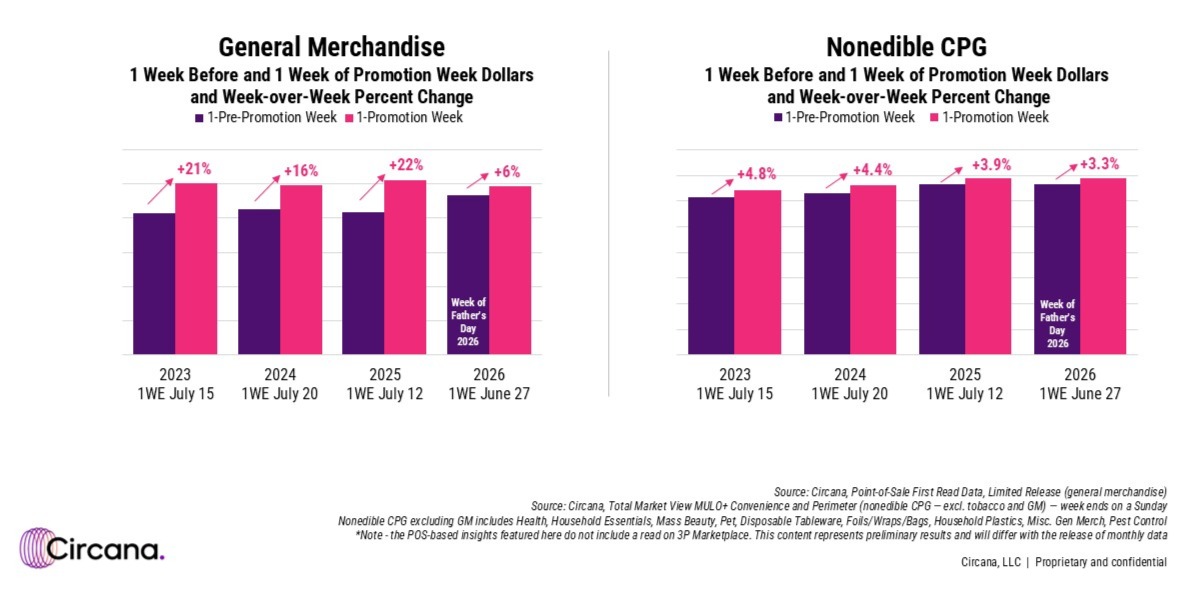
This year’s earlier summer promotional events generated a noticeable one-week sales lift across discretionary general merchandise and nonedible CPG categories. While these events remain effective at driving volume and capturing consumer attention, their ability to generate substantial incremental demand appears to be weakening. Analysis shows that the week-over-week increase associated with this year’s promotional period was smaller than comparable events in prior years, including those that occurred during the traditional July time frame. At the same time, the spending pullback surrounding promotional periods has become more pronounced, limiting the overall benefit retailers receive.
“Consumers increasingly expect promotions as part of the everyday shopping environment,” said Cohen. “While promotional events still generate excitement and urgency, discounts alone are no longer enough to drive meaningful behavioral change.”
Consumer and Retailer Priorities Continue to Shift
The timing of this year’s events wasn’t the only change. The products promoted and purchased during these periods continue to evolve as consumers prioritize value and manage ongoing economic pressures. Historically, July promotional events centered heavily on back-to-school shopping. However, beginning last year and continuing into 2026, retailers have shifted greater emphasis toward everyday essentials and higher-priced categories such as technology. Both have gained prominence during promotional periods as shoppers seek practical opportunities to save and place increased emphasis on value. School-related categories were missing from the top-performing retail segments during this year’s early summer promotions. This year’s highlights were some of those higher-ticket tech products, beauty, toys, skin care, and nutrition and weight-loss related products.
Back-to-School Spending Expected to Remain Delayed
The focus and timing shifts of promotions have further reduced the visibility of early back-to-school purchasing. Compounded with consumers increasingly embracing a “buy now, need now” mindset — delaying purchases until the need becomes immediate — and much of this year’s back-to-school shopping season is expected to occur later than in years past. Whether purchasing cold-weather apparel, backpacks, footwear, accessories, or replenishment items, shoppers are demonstrating greater willingness to postpone purchases until closer to the start of the school year, when temperatures drop, or until existing products need replacement.
“Promotions have become constant, making the message behind the promotion just as important as the offer itself,” added Cohen. “There is no single correct approach to promotional participation, but brands and retailers who prioritize convenience, relevance, and timely messaging will be best positioned to drive engagement in an environment where consumers have no shortage of opportunities to spend.”