By Bryan Gildenberg
If you’ve been trying to figure out what’s going on with tariffs, inflation and the general state of the economy lately the public narrative is deeply confusing. The headlines bounce between optimism and alarm, data tells one story while shoppers feel another — and businesses are struggling to plan as news flashes, projected forward, change the P&L by millions of dollars.

We are in the era of Certain Uncertainty. Waiting for stable ground is, unfortunately, a waste of precious time. It’s about learning to find footing on shifting sand. The businesses that win are the ones who CUE up success — not by seeing through the fog, but by knowing how to operate in it.
There are four key factors about this era and one core conclusion on how to manage it. All tariff data below was as of July 15, which means the only thing 100% certain about the data below is that something has changed between writing this piece and publishing it.
The TIP of the CUE:
tariffs, inflation profits
Why haven’t tariffs shown up more clearly in inflation numbers? The categories most tariff sensitive are ones that have lagged inflationary impact.
On July 15, CPI data ticked up and —for the first time — we started to see some early signs of tariffs pushing prices in categories like toys and electronics. But, for tariff rates projected to be from 10% to 40% it seems inconceivable that so far the data is not showing inflationary pressure.
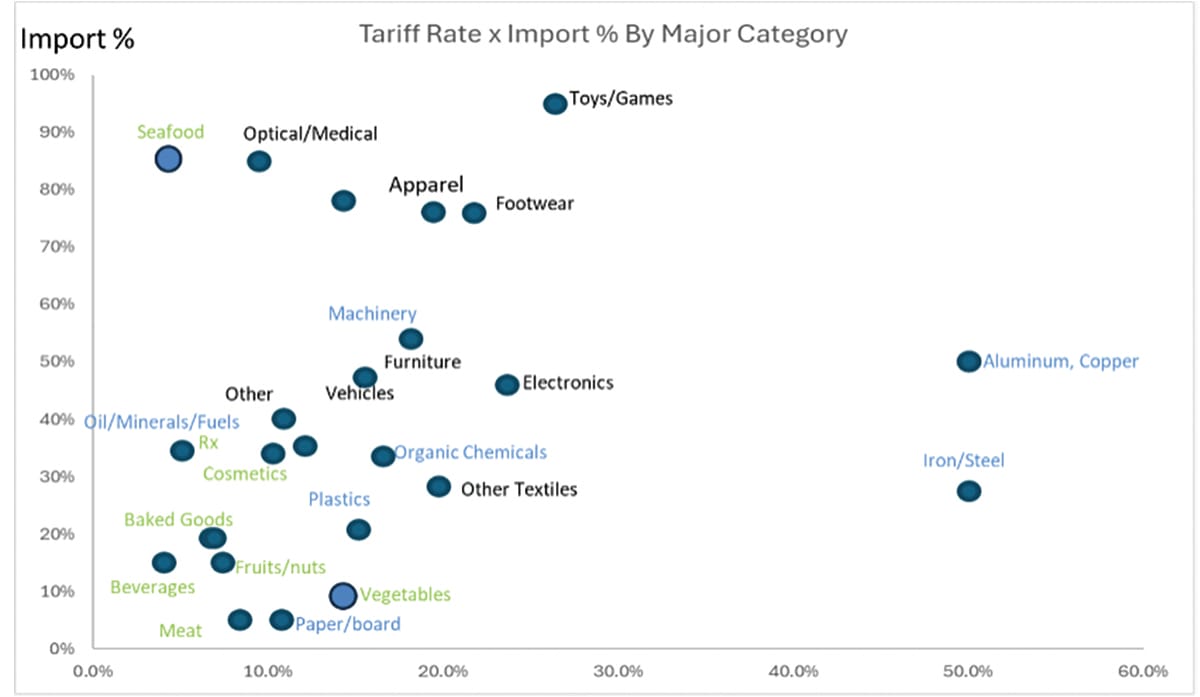
Retail Cities puts together a tariff intensity chart by category that looks at the tariff rate by country, depending on country of origin and the percent of the category that are imports. What is quickly apparent are that tariffs are largely in two areas:
• Discretionary goods (like furniture, toys, games and electronics), which make up a small slice of the consumer wallet.
• Ingredients that pass through to finished goods inconsistently, and often with a long delay (organic chemicals, paper, metals).
Most of the products in green on this chart are where consumers would feel inflation’s impact fastest. Today, most of the real challenge posed by tariffs has been to businesses sourcing raw materials or ingredients, rather than on consumer-facing goods.
How badly will tariffs impact inflation?
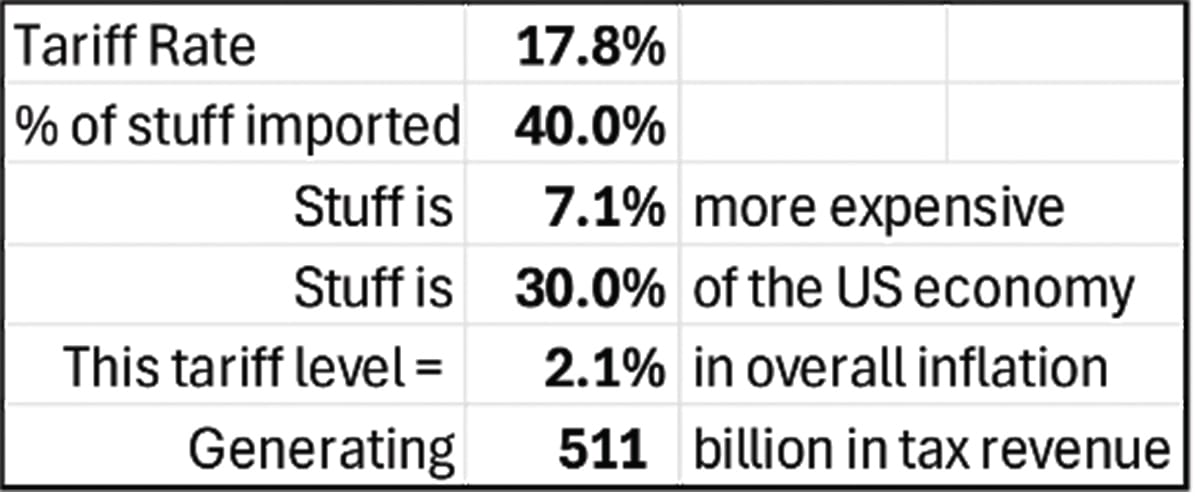
And this leads us to the second key point: Even though the average tariff rate is around 17.8%, and about 40% of goods sold in the U.S. are imported, the impact is still relatively muted. Why?
Because only 30% of the U.S. economy, and about 35% of the CPI basket, is “stuff.” The rest? Services. Haircuts. Healthcare. Housing. Streaming subscriptions. None of which are directly affected by tariffs.
This keeps the impact of this level of tariffs to a relatively manageable 2.1% change in the price of things in the economy overall.
The narrative is outpacing the data
Here’s where it gets interesting. While tariffs aren’t driving much inflation in the numbers, they’re absolutely driving it in consumer sentiment.
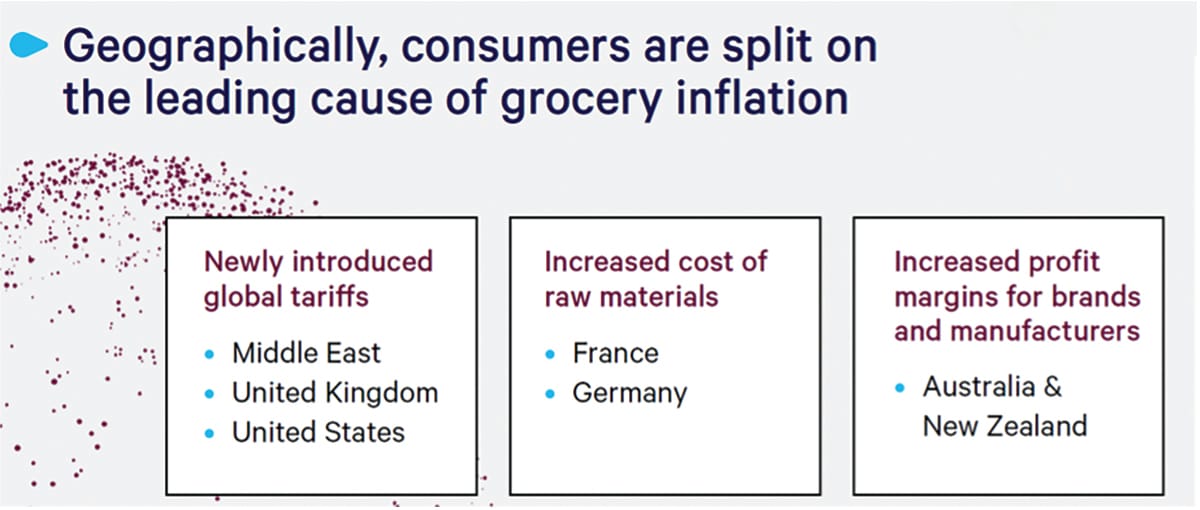
Blue Yonder data from a survey this summer spells it out: 88% of U.S. consumers are worried about grocery inflation, and more of them blame tariffs more than anything else — even though tariffs have little to do with food prices. That’s the narrative gap. And it matters.
The “Advantage360 2025 State of the Shopper Report” highlights this specifically — 79% of American shoppers are expecting higher prices due to tariffs and 37% are planning to change their shopping behavior as a result. The critical implication for brands and retailers is that price isn’t just a number — it is an emotional state as well. Shoppers shop based on how they feel. If they feel like prices are going up because of tariffs, they’ll start changing how they buy — switching brands, trading down or just cutting out categories entirely.
Perception drives behavior.
So if you’re a brand or retailer today, you’ve got to manage both the reality of inflation and the reality of belief about inflation.
Tariffs are the new multi-tool of policy
Today, tariffs are no longer just about trade policy. Increasingly, they’re being used as a negotiating tool for a broad spectrum of issues — supply chain reshoring, human rights enforcement, climate, even national security.
It seems likely that the next 12 to 24 months will contain a range of headlines that would trigger a revisiting of the P&L, only to see another headline hours or days later that will change that. We expect that this uncertain environment will continue to trigger short but intense swings in shopper behavior as well.
From ‘Predict the Future’
to ‘Sense the Present’ — Building a CUE Stick
That Works
So how do you lead through this?
One of the most important shifts for companies in this era is from prediction to sensing. From forecasting to feedback. From five-year strategies to real-time adaptations.
Here’s you CUE to win — ask two fundamental questions.
• Ask: What do we wish we knew in closer to real time?
Whether it’s customer response to price changes, supplier behavior under new tariff regimes or shifts in regional demand — getting these signals early can be the difference between skating and stumbling.
• Ask: What could we know faster if we tried?
There’s a ton of data you already have — POS, e-commerce search data, inventory turns, promotional elasticity — that could be mined more aggressively. The opportunity isn’t just in collecting more signals, but in activating the ones you already have.
This simple 2x2 chart and workshop is one of the key ways Retail Cities is helping clients build a business that can navigate Certain Uncertainty more effectively.
The last key point is to tie both of those insights into workflows that matter. Don’t just look at the data — make sure it can land in a place where it changes a decision, adjusts a price, triggers an alert or shifts a forecast.
Final thoughts:
CUEing up confidence
The businesses that win in a world of Certain Uncertainty will do so by building confidence, not certainty. Confidence in their ability to read signals faster. Confidence in their agility. Confidence in their teams’ ability to operate in ambiguity without freezing.
And above all: confidence in the consumer. Because despite the noise, the U.S. remains the largest and one of the fastest-growing retail markets in the world. This is not a story of panic. It’s a story of calibration.
So don’t wait for the world to make sense. Build systems that help you make sense of the world.
Bryan Gildenberg is founder and chief executive officer of Confluencer Commerce.