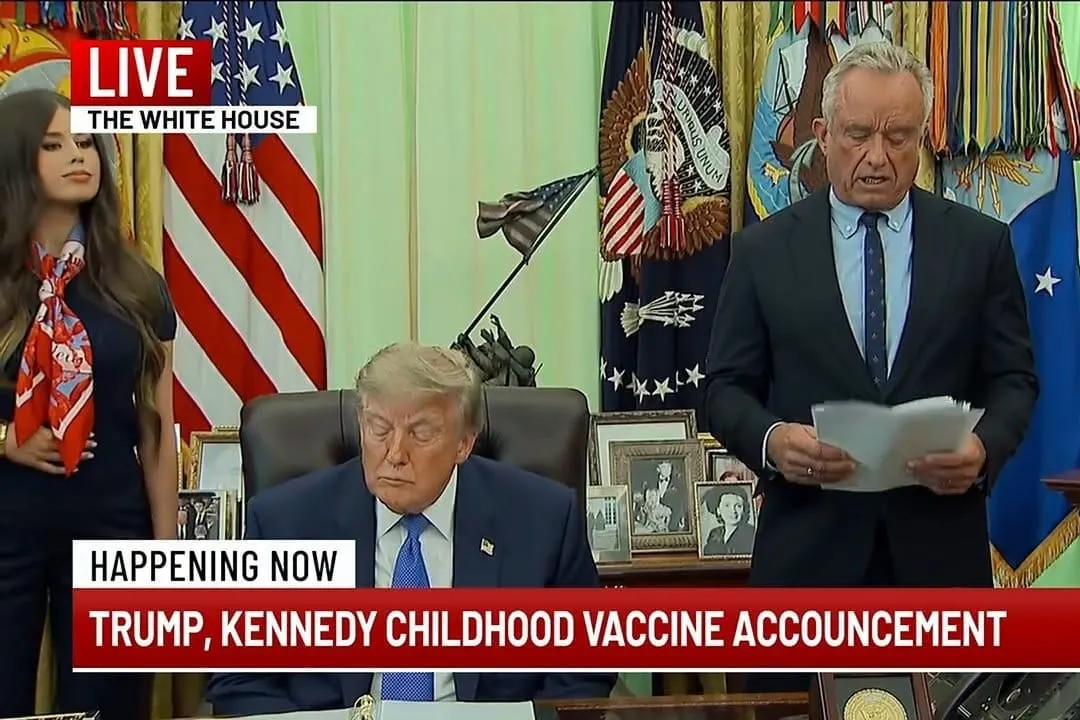
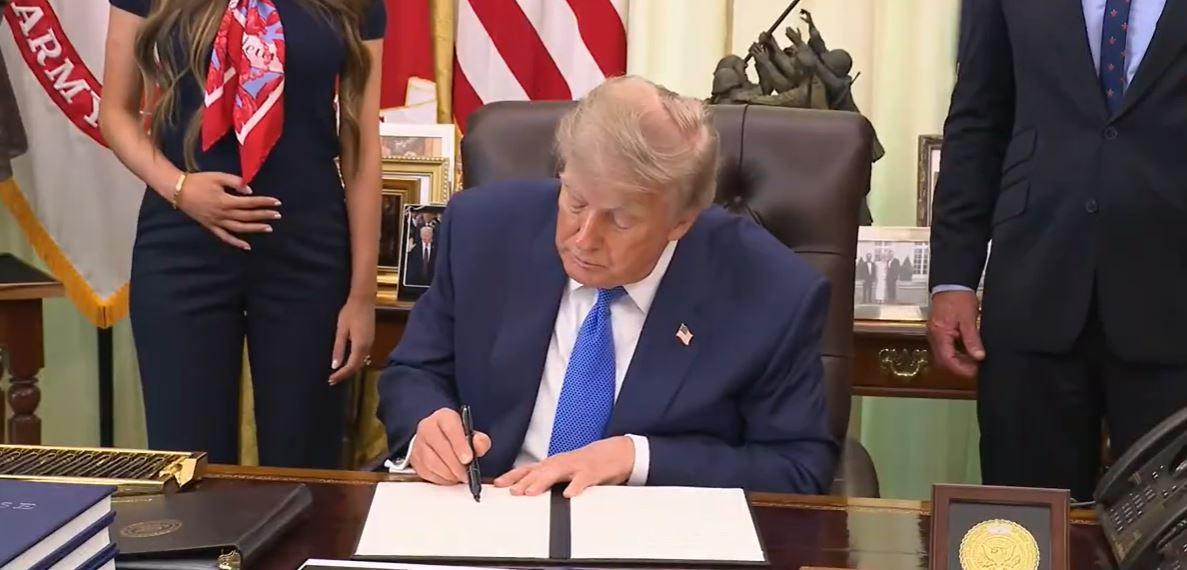
WASHINGTON — President Donald Trump has signed an executive order seeking sweeping changes to U.S. childhood vaccine recommendations, including reducing the number of diseases for which vaccines are universally recommended, separating the combined measles, mumps and rubella vaccine into individual shots, and spacing childhood immunizations across separate medical visits.
The Aug. 10 order, titled “Delivering Gold Standard Childhood Vaccine Recommendations for Americans,” marks the administration’s latest effort to reshape federal immunization policy under President Trump and Health and Human Services Secretary Robert F. Kennedy Jr.
The order recognizes a new framework that divides childhood immunizations into three categories and recommends routine vaccination against 11 diseases for all children, compared with 18 diseases in the Centers for Disease Control and Prevention’s 2024 recommendations, according to the White House.
Under the administration’s framework, the recommended vaccines for all children protect against measles, mumps, rubella, diphtheria, tetanus, pertussis, polio, Haemophilus influenzae type B, pneumococcal disease, human papillomavirus, and varicella.
A second category recommends immunizations for certain high-risk populations, including protection against hepatitis A, hepatitis B, meningococcal disease, and dengue, as well as monoclonal antibodies against respiratory syncytial virus. A third category places vaccines, including influenza and COVID-19, under shared clinical decision-making between families and health care professionals. Some vaccines, including hepatitis A and hepatitis B, appear in more than one category depending on an individual child’s risk.
The order could have significant implications for the nation’s immunization infrastructure, including retail pharmacies, physician offices, vaccine manufacturers, and insurers, though many of its provisions will require additional federal action before implementation.
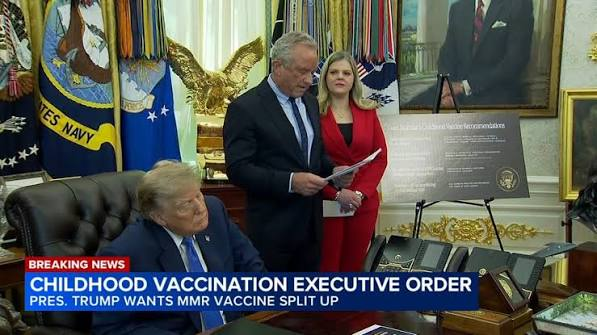
One of its most consequential provisions calls for the combined MMR vaccine to eventually be replaced by three single-disease shots. The order says measles, mumps and rubella should be administered separately once individual products become available domestically.
Those products are not currently available as separately licensed vaccines in the United States. The order directs HHS to work with the private sector and other countries to develop options for administering the vaccines separately while maintaining access to combination vaccines. HHS has 90 days to present plans to the president addressing that issue and other proposed changes.
The order goes further by recommending that, “to the maximum extent feasible,” childhood immunizations be administered during separate medical visits rather than administering multiple vaccines during the same appointment.
That approach conflicts with longstanding federal immunization guidance that supports simultaneous administration when appropriate. CDC guidance states there is no medical basis for routinely administering the measles, mumps and rubella components separately and that separating vaccines can delay protection against diseases.
According to current CDC information, children generally receive two MMR doses, with the first at 12 to 15 months and the second at 4 to 6 years. The MMR vaccine can also be administered at the same time as other vaccines.
During the signing, Trump argued that children receive too many vaccines in individual visits and repeatedly raised the possibility of a link between vaccines and autism. Decades of scientific research have found no causal association between childhood vaccination and autism. The Associated Press reported that Trump’s comments came despite scientific consensus and studies involving millions of children that found no such link.
Trump described the executive order as a victory for parental rights and said the administration aims to give families greater control over the timing of childhood vaccinations.
The White House said the policy aims to align the United States more closely with vaccination practices in other developed countries. An HHS assessment commissioned by the administration found that the United States recommends more childhood vaccines than peer countries and argued that many other nations rely more on education and public confidence than on vaccination mandates.
Medical organizations, however, have challenged both the administration’s conclusions and its proposed approach.
American Academy of Pediatrics president Andrew Racine said the changes risk creating uncertainty among parents at a time when vaccine-preventable diseases remain a public health concern.
“Science about vaccines and their efficacy has not changed,” Racine said. “The distribution of viruses and other pathogens in our environment has not changed. Children in this country have not changed in the last 48 hours.”
Sen. Bill Cassidy, R-La., a physician and the chairman of the Senate Health, Education, Labor and Pensions Committee, also publicly rejected the president’s approach.
“I’m a doctor. This executive order is wrong,” Cassidy said. “The President does not have the expertise to make these changes.”
The American College of Physicians warned that separating vaccines and requiring additional appointments could create new barriers to immunization, including additional copays and logistical burdens for families.
“This executive order is part of a troubling pattern by the administration to attempt to unilaterally change vaccine guidance, particularly for children, rather than relying on the transparent, scientific review that has guided the U.S. childhood vaccine schedule for decades,” said Jan K. Carney, president of the American College of Physicians.
ACP said the changes could increase costs for patients and families and require parents to schedule multiple appointments to complete an MMR vaccination series.
The potential operational effects could extend to pharmacies and other vaccination providers. A shift toward more appointments and individual vaccine products could alter ordering and inventory requirements, reimbursement patterns, appointment scheduling and patient counseling. Those effects would depend heavily on how HHS, CDC, FDA, insurers and states ultimately respond to the order.
The directive itself does not immediately rewrite state vaccination requirements.
States retain primary authority over vaccination requirements for school attendance. The executive order advises states and territories to review their existing laws and consider aligning them with the administration’s new recommendations, but it does not directly eliminate state mandates.
The administration is also seeking to challenge certain state policies. The order directs the attorney general to support what it describes as meritorious legal challenges to state laws that conflict with federal constitutional or statutory obligations related to parental authority, religious freedom, disability accommodations, and equal protection.
The Justice Department, the Department of Education, and HHS are similarly directed to ensure that federal contractors and grant recipients comply with applicable federal protections regarding vaccine exemptions.
The order also directs the HHS Task Force on Safer Childhood Vaccines to conduct a broader review of vaccine policy.
Within 90 days, HHS is expected to present plans to make individual measles, mumps and rubella vaccines available; to assess the timing and sequencing of childhood vaccines; to study alternatives to aluminum-containing adjuvants; to continuously evaluate vaccine risk-benefit profiles; and to expand vaccine safety monitoring, research and transparency.
The administration’s ability to translate those directives into a new national vaccine schedule remains uncertain.
Federal childhood vaccine recommendations have traditionally been developed by the CDC and its Advisory Committee on Immunization Practices, with final approval by CDC leadership. Previous Trump administration efforts to change the childhood schedule have faced legal challenges, including litigation over changes to the vaccine advisory committee's composition and federal recommendations. The executive order itself acknowledges that implementation of earlier administration directives has been delayed by litigation.
At the state level, the immediate effect is also limited because states continue to control school vaccination mandates. The AP noted that the order can put political pressure on states to reconsider their policies, but it does not supersede those requirements.
The policy shift comes as public health officials are already grappling with declining childhood vaccination coverage and renewed outbreaks of vaccine-preventable diseases.
Federal data show that kindergarten vaccination rates have been declining, while the percentage of children receiving exemptions reached a record high during the 2024-25 school year. The United States is also contending with ongoing measles transmission, raising concerns about the country’s longstanding measles elimination status.
Studies have also found that combination vaccines can improve completion rates. Research on U.S. infants and toddlers has shown that children receiving combination vaccines were more likely to complete recommended vaccinations by age 2 than those receiving individual shots.
For pharmacies and other immunization providers, the practical consequences will depend on what happens next at HHS and CDC, whether FDA-approved individual MMR products become available, and whether states or insurers change their policies in response.
For now, the executive order sets the administration’s preferred direction for childhood vaccination policy rather than immediately replacing all existing vaccination requirements or clinical protocols.
The White House says federal agencies should take steps within their existing legal authority to advance the new recommendations. HHS, meanwhile, faces a 90-day deadline to develop the next stage of implementation, which will trigger another round of decisions on vaccine availability, scheduling, reimbursement and access that could directly affect pharmacists and other front-line immunization providers.
Submit Your Press Release
Have news to share? Send us your press releases and announcements.
Send Press Release